
Which Records Reveal Productivity Loss?
Connect operating time, consumption and output to decisions that improve resource management.
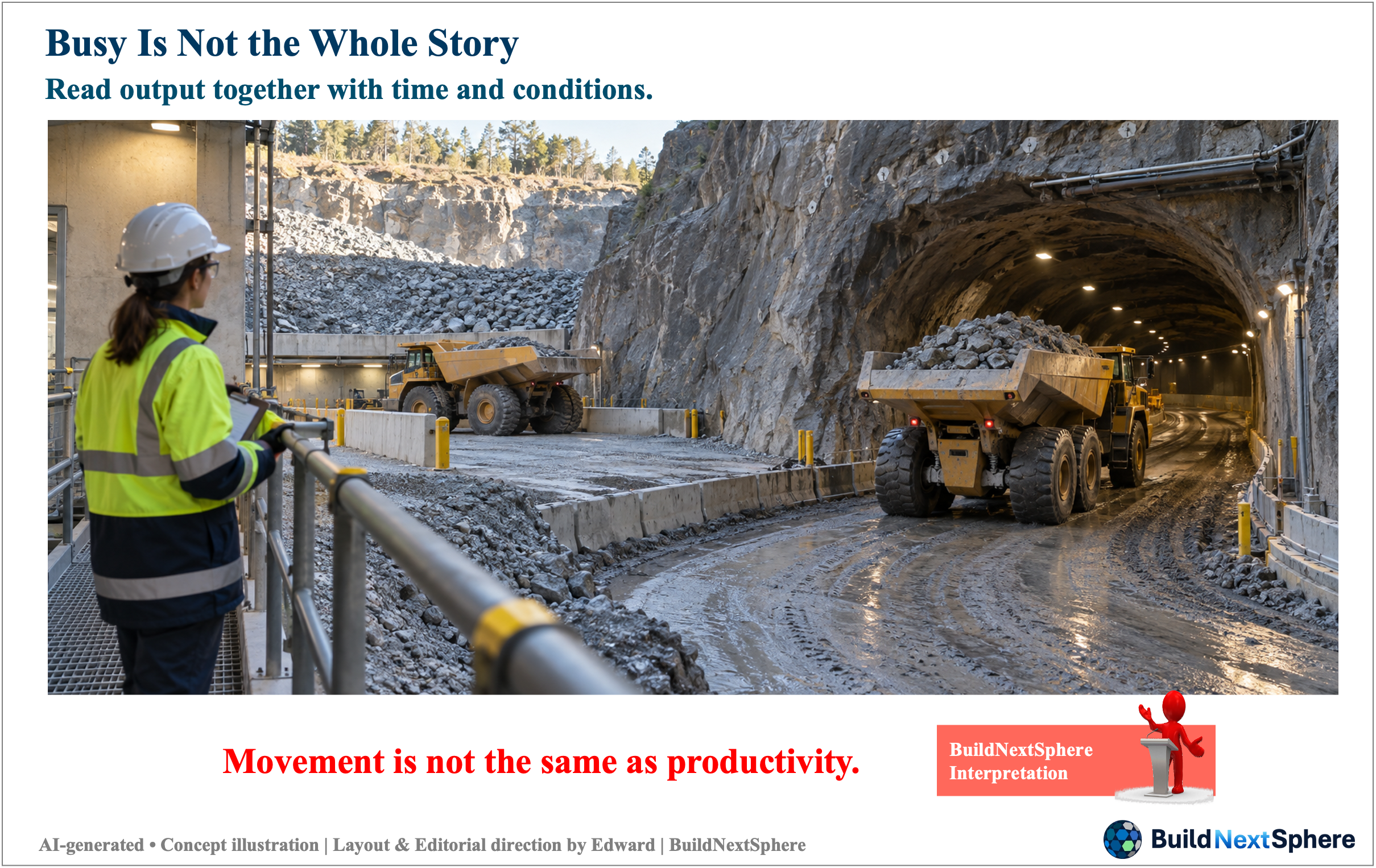
Source: AI-generated concept illustration; layout and editorial direction by Edward Kim | BuildNextSphere.
Note: The contrasting vehicle states are illustrative, not measured productivity results.
Busy equipment leaves unanswered questions
A busy machine is easy to see. The reason it is not producing the expected output is harder to see. A utilisation figure may show activity without showing whether the machine was doing productive work, waiting for another operation or repeating a task. A trip count may show movement without describing the haul route or what happened between trips. These records answer different questions; none should silently stand in for the others.
For BNS, the RPI direction begins with a practical question: which records need to meet before a resource decision becomes defensible? The purpose is not to collect everything about every person. It is to connect planned work, actual output, time, consumption and operating conditions so that a supervisor can investigate a loss and choose an appropriate response.
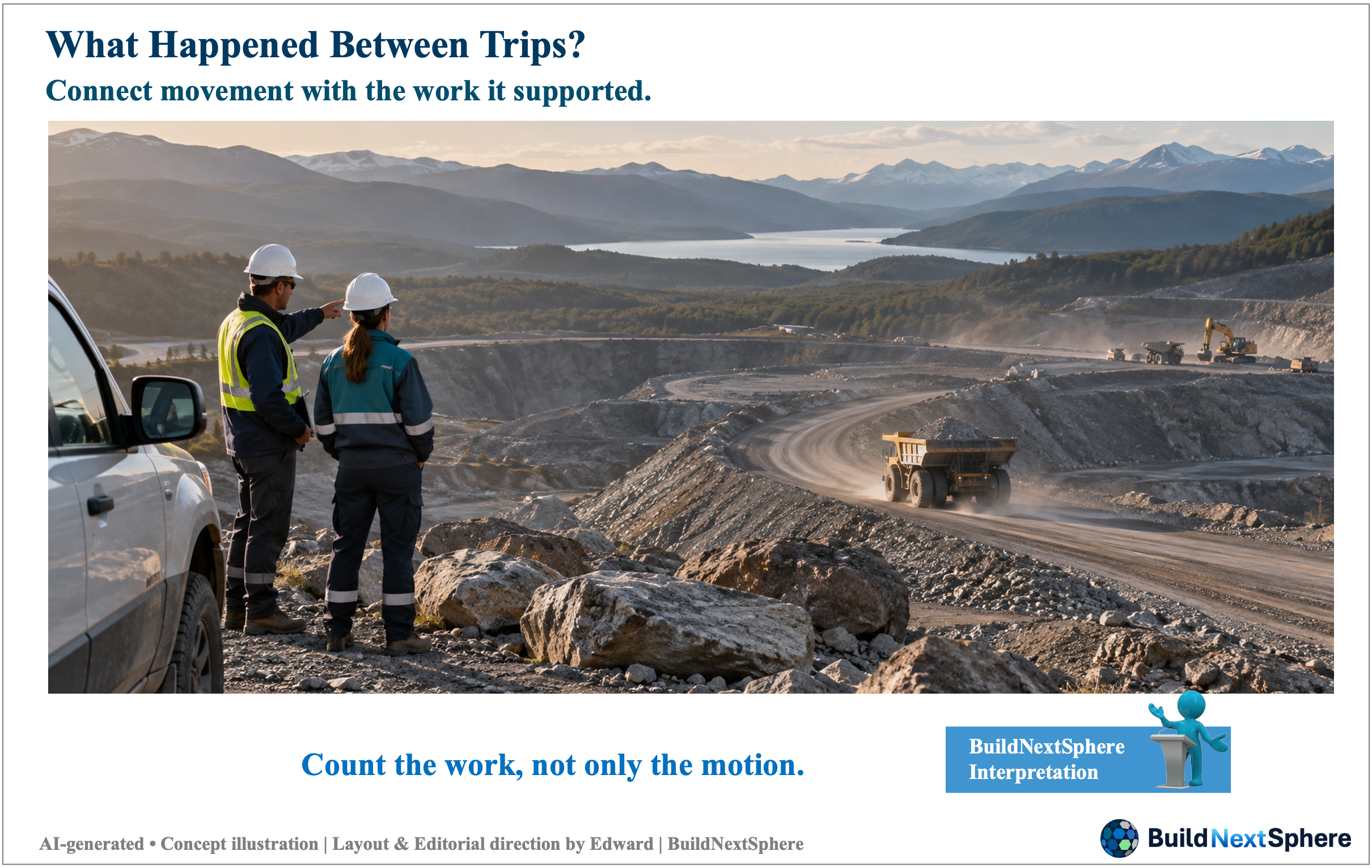
Source: AI-generated concept illustration; layout and editorial direction by Edward Kim | BuildNextSphere.
Note: A hypothetical haul setting; no cycle time, output or operator performance is inferred.
Start with the dump-truck operating record
On a UAE underground-storage project, Edward used a combination of operating records to review dump-truck performance. These included trip counts, fuel and tyre consumption, breakdown information and rest time. The combined analysis also informed rewards. This was an operational management practice, not a claim that a single indicator could objectively rank every driver under every condition.
The important lesson is the connection between records and a real decision. More trips may look favourable while consumption or breakdowns point to a different question. Fewer trips may reflect a constraint outside the operator’s control. The historical account confirms the scope of the review; it does not supply a public scoring formula, a verified improvement percentage or permission to publish individual performance records.

Source: AI-generated concept illustration; layout and editorial direction by Edward Kim | BuildNextSphere.
Note: Inspired by Edward’s combined truck-record review; no actual scoring weights or employee records shown.
Compare like work under visible conditions
A useful comparison starts with a common task, time period and unit. Before comparing two shifts, ask whether their routes, distances, loads and available working time were comparable. Keep observed facts separate from explanations: a recorded wait is a fact about time, while the reason for that wait may still need confirmation. Missing records should remain visible rather than being converted into assumed idle time.
This changes the conversation from who appears slow to what prevented the work. It may lead to checking loading capacity, access, coordination, equipment condition or the plan itself. These are review candidates, not conclusions drawn from a low number. Any employee assessment must retain the relevant working conditions and give the responsible reviewer a way to question the comparison.
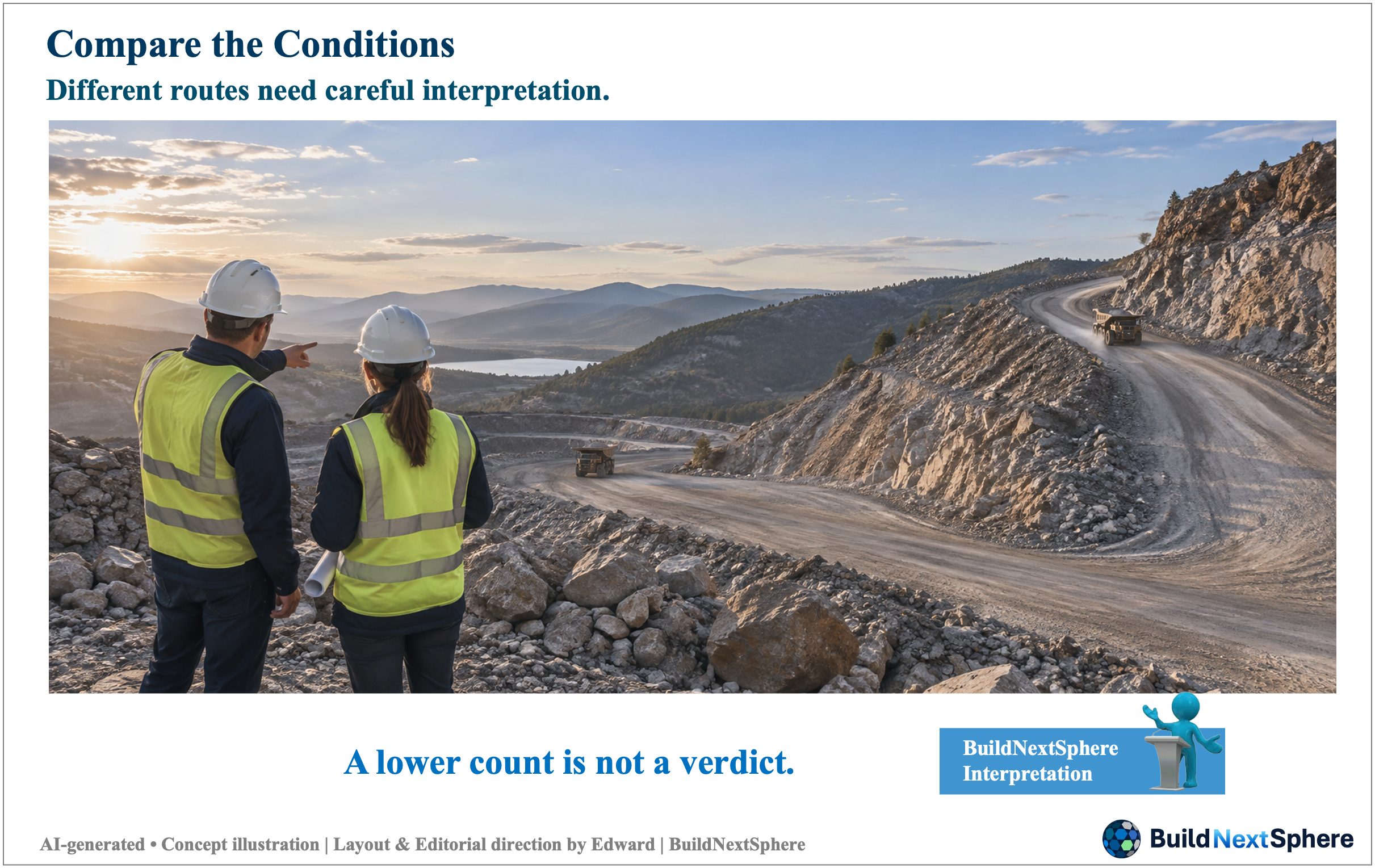
Source: AI-generated concept illustration; layout and editorial direction by Edward Kim | BuildNextSphere.
Note: Routes are illustrative; no quantitative comparison or attribution of worker responsibility is made.
Turn analysis into operating choices
Edward’s operating experience extended beyond trucks. Team-level reviews separated planned and actual work, including net working time, waiting, site arrival and schedule-update records. For major drilling equipment, actual utilisation was also considered alongside spare-parts and consumable needs. Long import lead times made advance preparation an operating concern rather than merely a stores issue.
Excavation output in relation to drilling work also informed reviews involving drilling operators and blasting supervision. The transferable point is to connect output to the work that produced it, not to publish an unconfirmed universal productivity formula. A maintenance decision, a revised allocation and a reward decision need different evidence and authority, even when they reuse some of the same records.
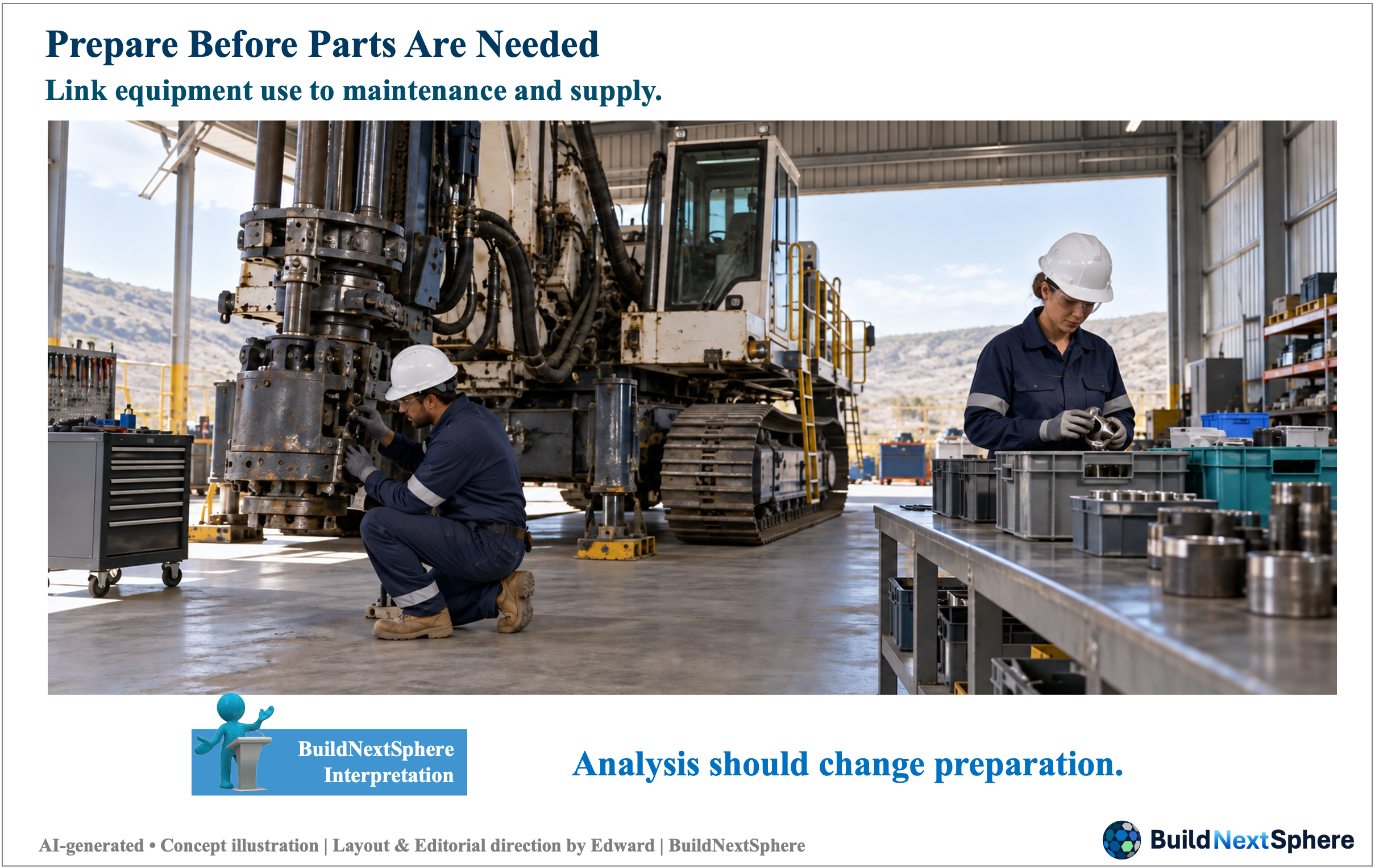
Source: AI-generated concept illustration; layout and editorial direction by Edward Kim | BuildNextSphere.
Note: Concept scene for utilisation-informed preparation, not a verified forecast or inventory recommendation.
Review a resource through six linked fields
For one resource, build a review around six linked fields: the task and period; planned and actual output; working and waiting time; consumption and breakdowns; operating conditions and evidence; and the decision with its follow-up. Start with records already captured through the work. Every additional field should justify the burden it places on the person supplying it.
This proposed review aid is not a finished screen or a required scoring model. Its test is whether the next action is clearer. If a loss remains unexplained, record the question and who will check it. After an adjustment, examine what changed and what did not. Closing a report is not the same as resolving the operating constraint.

Source: AI-generated concept illustration; layout and editorial direction by Edward Kim | BuildNextSphere.
Note: Symbolic review objects, not a prescribed data model or disclosed operational report.
Reuse the evidence across planning and supply
In the proposed PIS structure, WEI supplies task-linked operating information, RPI examines resource use and productivity, PSI considers the supply response, and PCI carries relevant evidence into project forecasts. DKI supports traceable records. These connections describe a development direction, not completed integrations or eight released products.
AI could help find unusual combinations, compare alternatives or prepare review material, but those capabilities require testing against the actual data and conditions. People remain responsible for the interpretation and authorised response. Choose one resource review on your project: can you trace the conclusion back to comparable work, and can you trace the analysis forward to a decision? That is a more useful starting point than another utilisation chart.

Source: AI-generated concept illustration; layout and editorial direction by Edward Kim | BuildNextSphere.
Note: Proposed cross-function coordination; not evidence that PIS integrations are complete.
Sources
No external sources cited. The experience account is based on Edward Kim’s direct project experience and subsequent clarifications.
Basis of This Article
The operational examples are Edward Kim’s first-hand account of team and equipment reviews on a UAE underground-storage project. Public scoring weights, individual records and improvement rates are not provided. The six-field review and future PIS/AI connections are proposals, not evidence of a released product.
Related Reading
Explore more from BuildNextSphere:
• Why Do Busy Crews and Equipment Not Always Mean Higher Productivity?
• Why Do Projects Fail to Execute the Plan?
• Between the Plan and the Site: How Can AI Support Project Execution?
BuildNextSphere
BuildNextSphere connects Development, Technology & Project Intelligence through practical, experience-informed content.
About the Author
Edward Kim is the Founder of BuildNextSphere. He draws on his experience with overseas construction projects to share practical insights from field operations, project delivery, and IT-enabled working systems. Through BuildNextSphere, he explores how people, technology, and real project conditions can help turn plans into action and support better project outcomes.
Content & IP Notice
This article and related materials are prepared by BuildNextSphere. Unless otherwise stated, the original structure, wording, diagrams and visual materials are the intellectual property of BuildNextSphere and Edward Kim. BuildNextSphere, its logo, tagline and brand assets are part of the BuildNextSphere brand identity. Unauthorised reproduction, modification, redistribution or commercial use is not permitted without prior written consent. Third-party names, technologies and references remain the property of their respective owners. General management principles are not claimed as proprietary inventions.