
Between the Plan and the Site: How Can AI Support Project Execution?
Introducing BNS Project Intelligence Sphere Platform — From Work Coordination to Responsible Decisions.

– Figure 1. Connecting Plans, Field Information and Action
– Note: This is a hypothetical scene, not a photograph of an actual project or a screenshot of the platform. The connecting lines are symbolic and do not represent implemented integrations or verified AI capabilities.
– Source: AI-generated concept illustration; layout and editorial direction by Edward Kim | BuildNextSphere.
01. The Plan Exists. The Coordination Still Takes Work.
A familiar starting point
Tomorrow’s concrete pour is in the plan. The reinforcement team has reported completion, and the supervisor expects the crew to start. Yet the inspection remains unconfirmed, Area B has requested the same pump, and the delivery route needs another check. In this hypothetical example, the missing pieces are not another schedule or another report. They are confirmations, decisions and actions that must come together before the work can proceed.
The manager between the records
A project manager or construction manager may have to connect these pieces through calls, messages and meetings. Each channel can be useful. The difficulty is establishing whether people are discussing the same activity, time and current condition. Adding more people to collect updates can also add handovers and coordination. The question is not simply how much information a team has, but how reliably that information reaches someone who can act.
The question for AI
This is where I would begin a discussion about AI in project execution. Can assistance help the team notice an unresolved condition, understand its implications and organise a response? Producing a polished answer is not the same as releasing a workfront. A useful system must fit the people, information and authority around the work. For a simple problem, a shared record and a clearer procedure may already be sufficient.
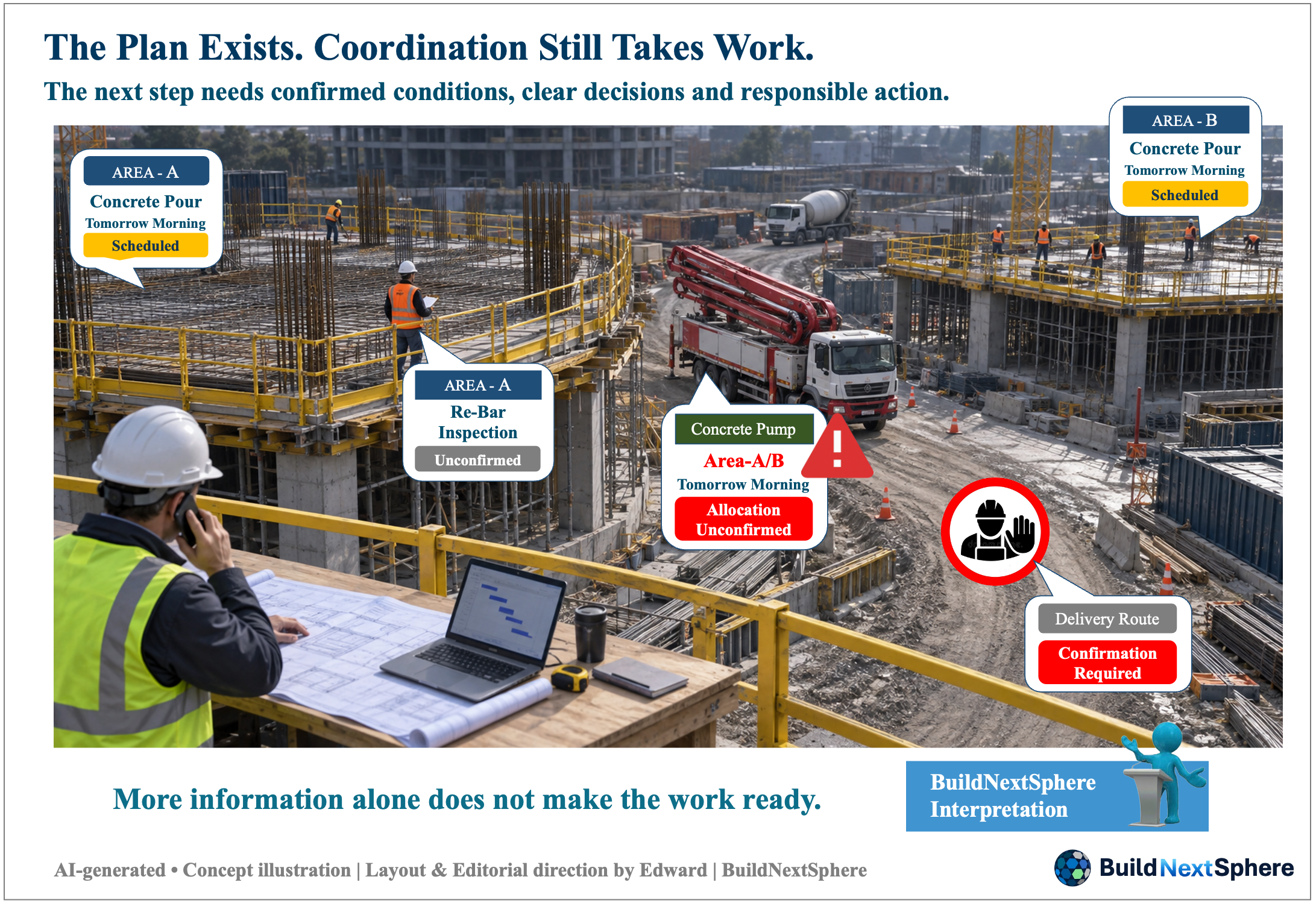
– Figure 2. Planned Work, Unconfirmed Conditions
– Note: This hypothetical scene illustrates two work areas requesting the same concrete pump while inspection and access conditions remain unconfirmed. It is not a photograph of an actual project or a representation of implemented platform capabilities.
– Source: AI-generated concept illustration; editorial direction by Edward Kim | BuildNextSphere.
02. A Platform Direction Grounded in Field Experience
An operating experience
On a large overseas underground construction project, I contributed to developing and implementing a mobile work-management system linked to control-room coordination. The arrangement brought together schedule-logic calculations, field updates and work instructions. Wireless-network arrangements supported underground communication and equipment-location information. These were parts of an operating system used in a particular project, not just an illustration of what software might eventually do.
What the experience changed
The experience showed me why connectivity, usable information and operational responsibility belong together. A control room was valuable when it helped people coordinate, not merely when it displayed more data. My experience in headquarters coordination and project recovery also informs this perspective. However, this account does not provide independently measured gains, and I do not describe the historical system as AI or as a completed version of the proposed platform.
From one project to wider use
The next challenge is to simplify and generalise that work-management experience. Another project may organise work packages, approvals, shifts and responsibilities differently. Reusing the idea therefore requires more than copying a screen. It means deciding which records and workflows should be common, which should be configurable, and how much input people can reasonably maintain. A system that helped one project still needs testing in another setting.
Experience is a starting point
The earlier BuildNextSphere articles approached related questions through people and support, operating readiness, technology and project coordination. Together, they inform the direction described here. They do not establish that a particular software design will work everywhere. Respect, competent supervision, access to resources and practical problem-solving remain part of delivery. The platform should support those conditions, not suggest that a digital record can substitute for them.

– Figure 3. Field Experience Behind the Platform Direction
– Note: Inspired by Edward’s account of an underground-project WMS, this illustration is not a photograph or an exact reconstruction of the project or its interfaces. The historical system is not presented as AI or as a completed version of the proposed platform.
– Source: AI-generated concept illustration; editorial direction by Edward Kim | BuildNextSphere.
03. Introducing BNS Project Intelligence Sphere Platform
The platform’s purpose
BNS Project Intelligence Sphere Platform is the name I have chosen for this development direction: a web and mobile platform intended to connect field information, work coordination and responsible decisions. It starts from practical work-management experience and aims to extend through focused modules. It is not a claim that a complete commercial platform, every proposed integration or its future AI capabilities are already available.
Knowledge and implementation
Within BuildNextSphere, the Project Intelligence series examines operating problems, management ideas and possible responses. The platform explores how those ideas could become useful records, workflows and assistance. The two should inform each other without turning every management discussion into a product claim. A concept can be valuable even when software is unnecessary; a software proposal still needs evidence that it fits the intended work.
A focused beginning
The initial focus is task management and communication among the people responsible for execution, particularly the needs of project managers and construction managers. The proposed first module is BNS Task Coordination Sphere. Its attention is on the coming week, day and shift: the work people need to understand and coordinate now. Wider project intelligence is the direction of travel, not the starting requirement for every user.
Modules with a common purpose
Here, Sphere expresses the intention to connect related areas of work. A module should solve a bounded problem while retaining the context needed by another team. The naming pattern does not mean that eight or more finished products already exist. The task-coordination starting point and the contract module direction have names; other boundaries, priorities and implementation choices remain to be developed.
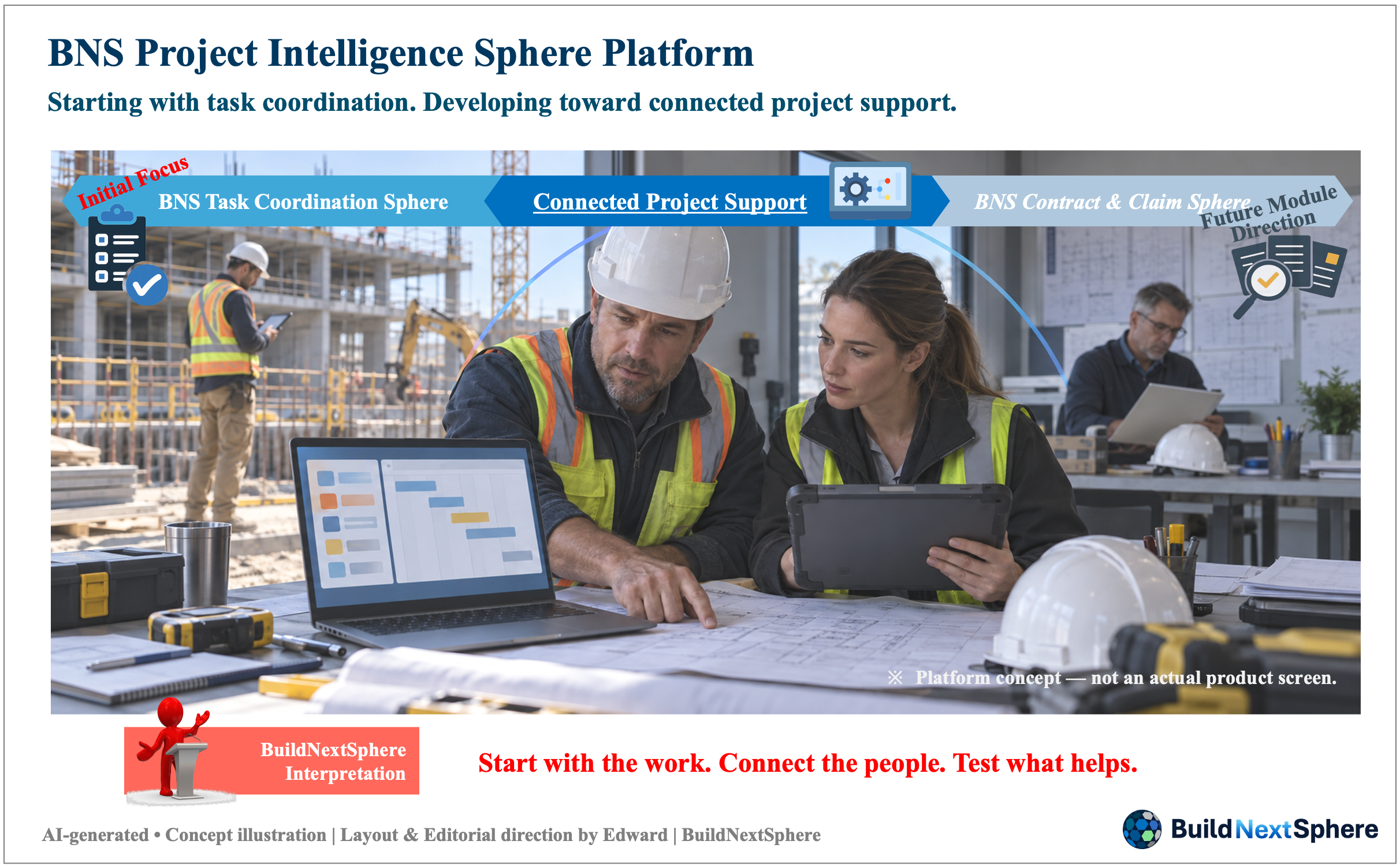
– Figure 4. A Platform Direction Starting with Task Coordination
– Note: This illustration presents the proposed platform direction, not an actual product interface. The devices and connecting arc are symbolic; they do not establish that the proposed modules, integrations or AI capabilities are available.
– Source: AI-generated concept illustration; layout and editorial direction by Edward Kim | BuildNextSphere.
04. What Task Coordination Could Look Like
One activity, connected conditions
Return to Area A. A proposed activity record would identify the pour, its location and intended start, then connect the inspection status, pump requirement and access information. Each update would show its source and confirmation time. An empty inspection field would remain unconfirmed. A pump allocation would identify the relevant period. This is a proposed workflow, not a screenshot or a statement of currently delivered functionality.
A decision with an owner
The pump conflict would need more than an alert. The team would examine both pours, their following activities and feasible alternatives. The record could identify who checks availability, who may decide the allocation, when a decision is needed and which delivery depends on it. Acknowledging a message would not mean approving a revised sequence. The outcome would return to the affected participants, with unresolved conditions still visible.
Less chasing, not less responsibility
The design aim is to reduce repeated requests for the same update while keeping responsibility clear. Participants would contribute the information relevant to their role; the engineer would review and coordinate rather than retype everything. Confirmation of action would include evidence that the missing condition had changed. That objective must be tested against actual input and review effort. Adding a new record can create work as well as remove it.
When the plan changes
If the pour moves to a later shift, the update should reach the crew, pump coordinator and supplier who depend on that timing. They need to know what changed and what remains unconfirmed, rather than simply receive a replacement file. The proposed system would preserve the reason and response history. Whether updates can be immediate will depend on connectivity, working arrangements and people maintaining the information.
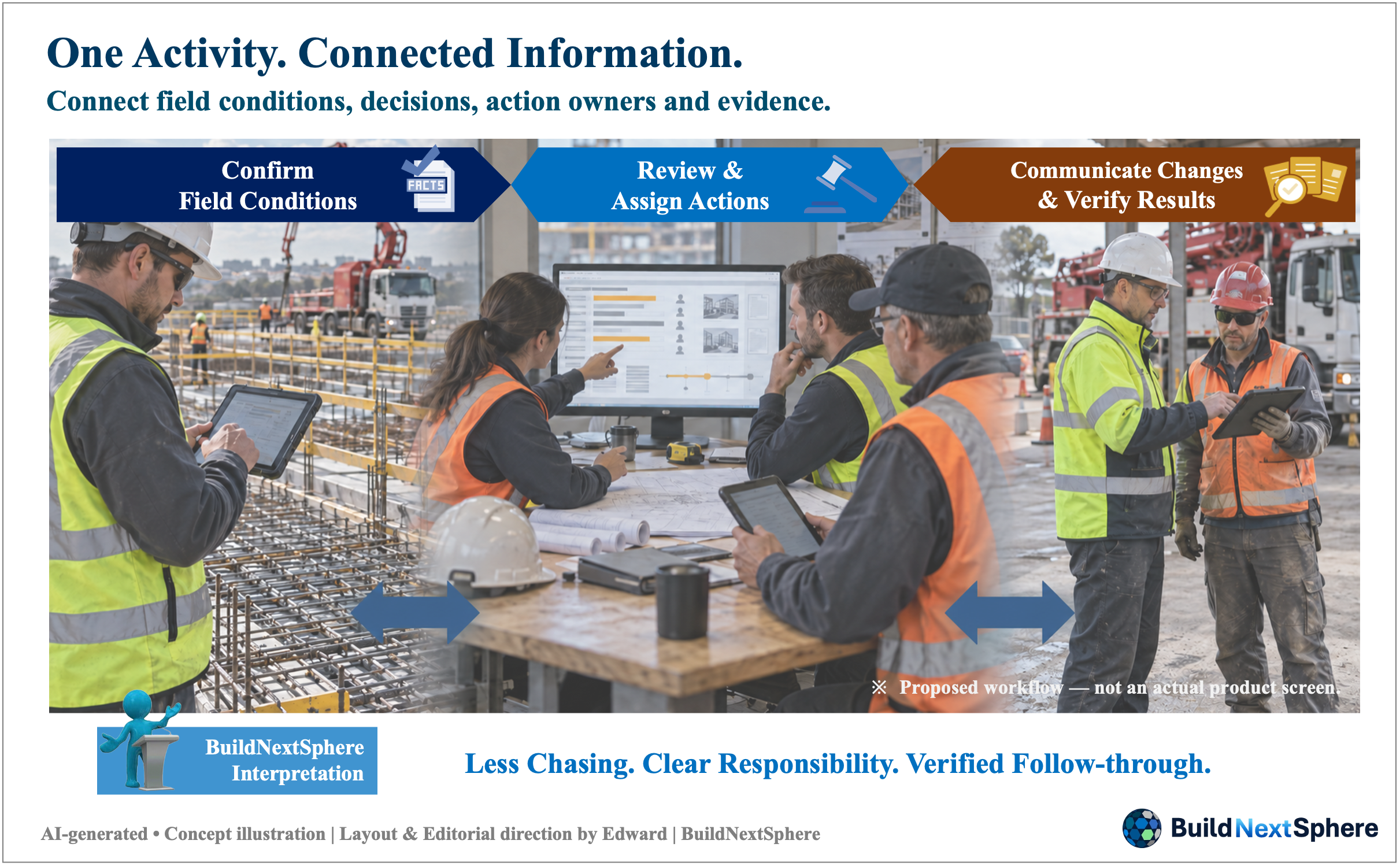
– Figure 5. Connecting Activity Conditions, Decisions and Follow-through
– Note: This conceptual montage illustrates a proposed coordination workflow, not a single continuous scene or an actual platform interface. It does not indicate that equipment allocation, inspections or permission to start work have been approved.
– Source: AI-generated concept illustration; editorial direction by Edward Kim | BuildNextSphere.
05. Add AI Where Assistance Is Useful
Assistance before autonomy
The first AI direction is assistance during record creation and daily operation. It could suggest a missing confirmation, identify potentially conflicting statements, retrieve related information or ask a useful follow-up question. These would be prompts for review, not proof that a condition is satisfied. The person receiving the suggestion would need to see the relevant source and decide whether the interpretation fits the work.
Analysis and early warning
The second direction is interpreting information across functions, such as connecting a delivery change with equipment needs and following activities. The third is early warning and decision support: helping people examine developing conditions and possible responses. These are staged development directions, not release commitments. Missing fields, overdue actions and overlapping bookings can also be checked with ordinary rules; useful warnings should not wait for an advanced AI model.
The boundary stays visible
Data links, schedule calculations, notifications and permissions are part of the underlying system, not automatically AI. Equally, an AI recommendation would not authorise a pour, change an approved baseline or approve a contractual response. The workflow needs named reviewers, decision rights, correction routes and an alternative when the system is unavailable or its output cannot be trusted. Supporting the engineer is different from transferring the engineer’s responsibility to software.
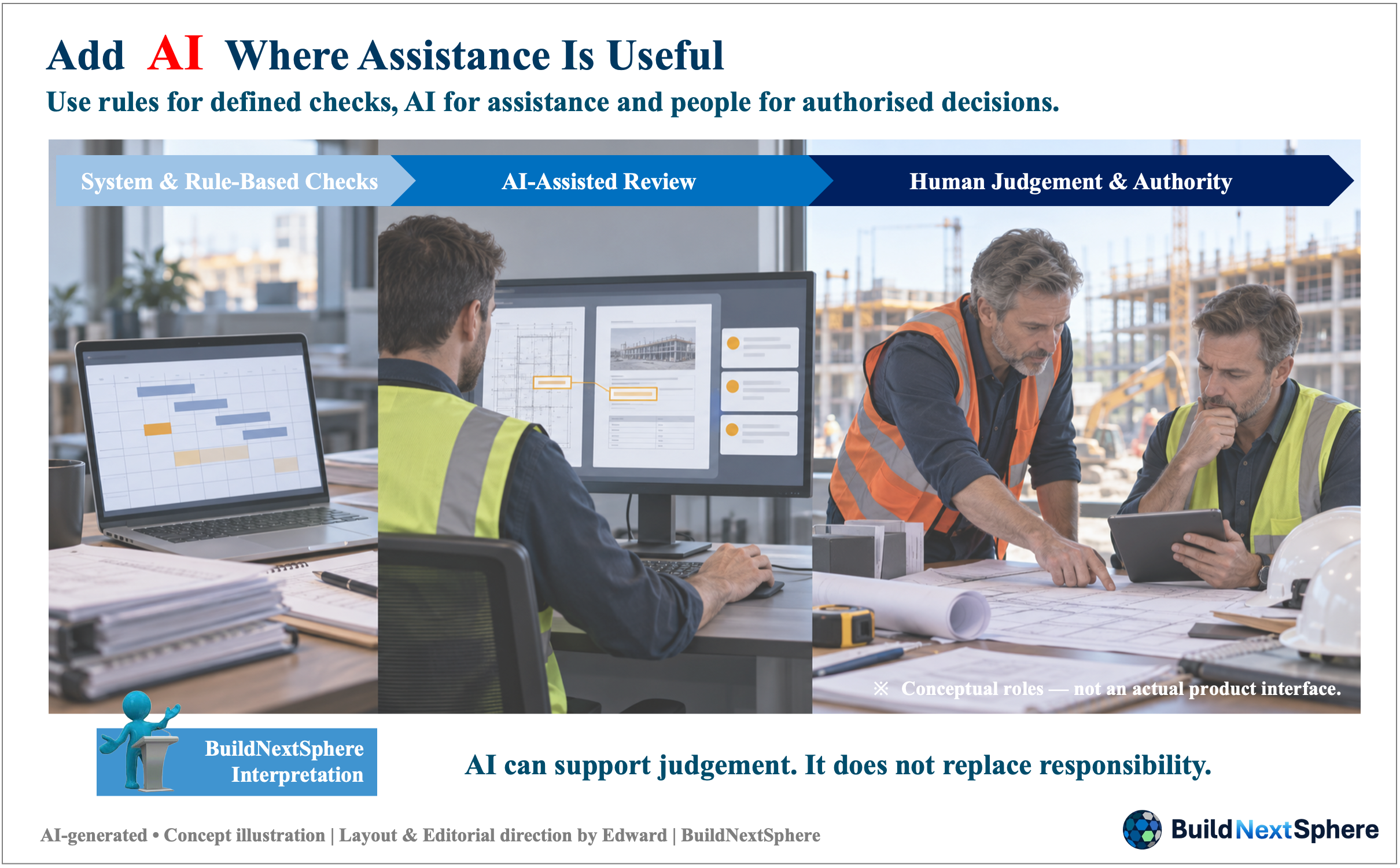
– Figure 6. Distinguishing System Rules, AI Assistance and Human Authority
– Note: The screens illustrate conceptual support roles, not implemented platform capabilities. Highlighted items are prompts for human review, not confirmed errors or approvals. AI suggestions do not authorise work or replace designated decision-makers.
– Source: AI-generated concept illustration; layout and editorial direction by Edward Kim | BuildNextSphere.
06. From Site Coordination to Wider Project Support
Contract events and review
BNS Contract & Claim Sphere is the name selected for a later module direction. A field event, instruction and supporting records could be connected to the people responsible for contractual review. Potential assistance might include finding relevant records and preparing a draft for review. An operational warning is not a formal contractual notice, and a recorded event does not establish entitlement. Applicable requirements and authorised approval remain essential.
Headquarters attention where needed
The longer-term direction includes resources, procurement, project controls and recovery across projects. A recurring equipment shortage might need procurement support; a problem exceeding site authority might require a management decision. The aim is not to send every issue to every department. It is to preserve enough context for the right person to respond, then show the site what was decided. These capabilities require further design and validation.
Connection without wholesale replacement
The platform is intended as a separate web and mobile environment, not an initial replacement for every scheduling, commercial or document system. Possible integrations must follow each project’s information ownership, permissions and update needs. Language, connectivity and local working practices also matter. A shared interface cannot remove a physical constraint: ventilation, access or equipment may still require a practical intervention and resources outside the software.

– Figure 7. Connecting Field Issues with the Right Project Support
– Note: This conceptual montage illustrates possible support connections, not a mandatory approval sequence or implemented platform integrations. Operational alerts are not formal contractual notices; contractual review and authorised decisions remain necessary.
– Source: AI-generated concept illustration; layout and editorial direction by Edward Kim | BuildNextSphere.
07. Start with One Workflow, Then Earn the Next Step
A testable beginning
A useful first trial would focus on one recurring coordination problem and record how it is handled today. Relevant measures might include decision waiting time, missing updates, reopened actions and the effort required to enter and review information. Training, staffing and work-scope changes should be recorded alongside the results. A faster report would not demonstrate better execution if the team still waits for the same decision.
The next question
For your next meeting, choose one activity and ask where the connection breaks: between the plan and current conditions, between an update and a decision, or between an assigned action and a checked result. That is the conversation I want to develop through BuildNextSphere. The ambition is broader project intelligence; the starting point is work that people can understand, coordinate and verify.
A direction to develop
Future articles will examine individual workflows and the assumptions behind them, including situations where a simpler response is better. Feedback from practitioners can help sharpen the questions, but interest alone is not evidence of adoption or performance. Expansion should follow what the intended users can maintain and what a trial actually demonstrates. Connect the facts. Assign the action. Verify the result.

– Figure 8. Starting with One Workflow and Testing What Helps
– Note: This hypothetical scene illustrates a small-scale workflow trial, not an actual project meeting or platform interface. It does not demonstrate measured improvements; expansion should depend on trial evidence and the users’ ability to maintain the workflow.
– Source: AI-generated concept illustration; editorial direction by Edward Kim | BuildNextSphere.
Sources
No external sources cited.
Basis of This Article
This article presents Edward Kim’s practical perspective and the proposed direction of BNS Project Intelligence Sphere Platform. The concrete-placement scenario is hypothetical. The anonymous underground-project account draws on Edward’s direct experience and is not an independently evaluated case study.
Past WMS implementation experience is distinct from a completed general-purpose platform or validated AI capabilities. The workflows and module directions described here require further design and testing against project conditions, applicable procedures and authorised responsibilities.
Related Reading
Explore more from BuildNextSphere:
- Why Doesn’t Better Technology Always Deliver Better Construction Results?
- Why Do Some Countries Advance While Others Miss Opportunities?
- The Future of Construction: Which Technologies will Really Change the Site?
- When Projects Don’t Go to Plan: What Are We Missing?
BuildNextSphere
BuildNextSphere connects Development, Technology & Project Intelligence through practical, experience-informed content.
About the Author
Edward Kim is the Founder of BuildNextSphere.
He draws on his experience with overseas construction projects to share practical insights from field operations, project delivery, and IT-enabled working systems. Through BuildNextSphere, he explores how people, technology, and real project conditions can help turn plans into action and support better project outcomes.
Content & IP Notice
This article and related materials are prepared and published by BuildNextSphere. Unless otherwise stated, the original structure, wording, diagrams, frameworks, and visual materials are the intellectual property of BuildNextSphere and Edward Kim.
BuildNextSphere, its logo, tagline, and brand assets are part of the BuildNextSphere brand identity. Unauthorized reproduction, modification, redistribution, or commercial use is not permitted without prior written consent.
Third-party names, technologies, or references are mentioned for informational purposes only and remain the property of their respective owners.
One Response