
The Future of Construction: Which Technologies will Really Change the Site?
Where AI can help—and what it takes to connect digital support with field execution.
By Edward | BuildNextSphere
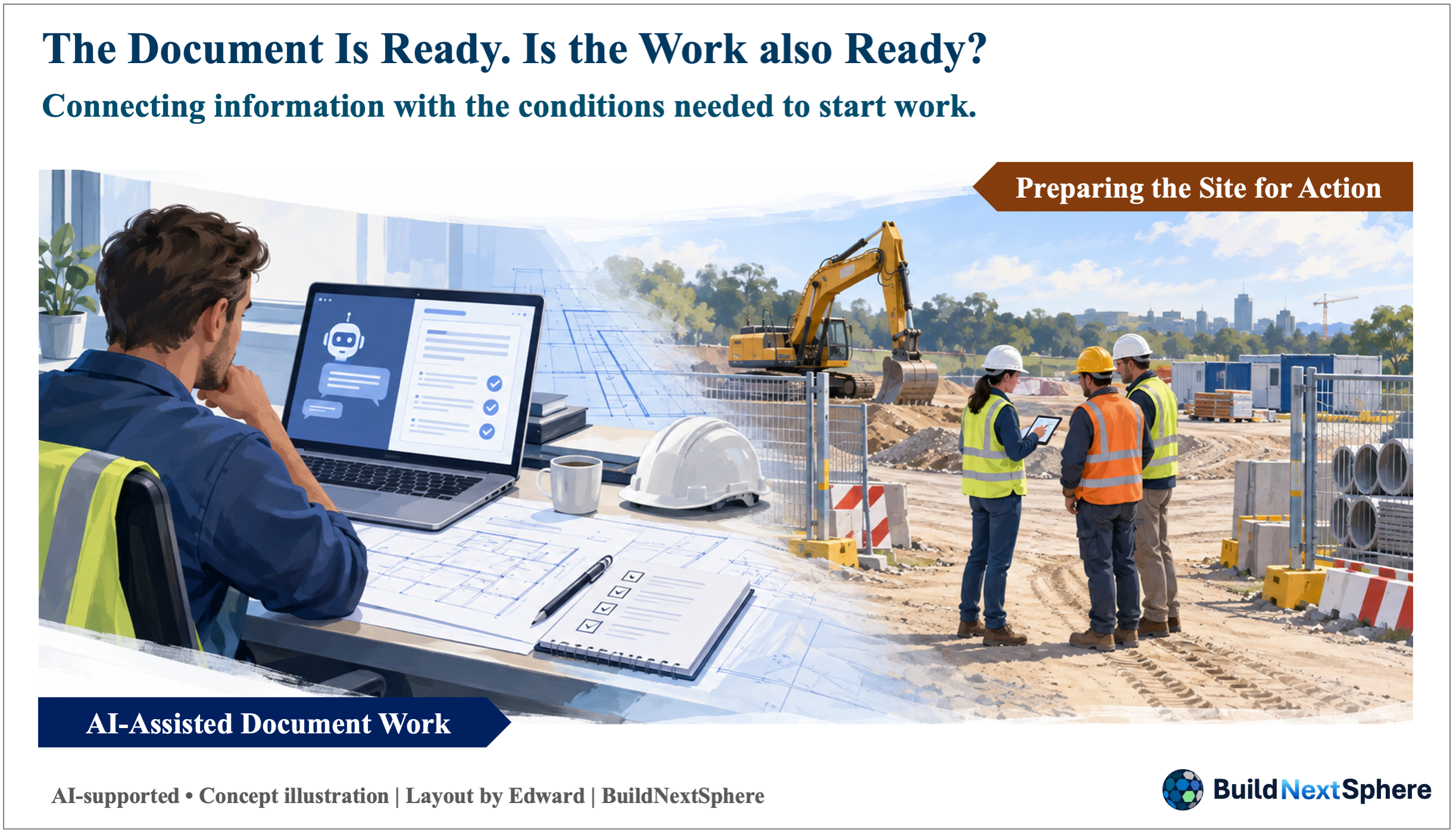
– Figure 01. The Document Is Ready. Is the Work Ready?
– Source: AI-generated concept illustration; layout and text by Edward | BuildNextSphere.
01. AI Can Change the Document—But What Changes the Work?
A meeting can end with a clear summary while the work it discussed remains blocked. A well-written instruction does not necessarily mean that access is available, equipment is ready or the next team understands what must happen. This distinction is a useful starting point for considering AI in construction.
In my own work, AI has been helpful in preparing meeting records, organising information and developing correspondence drafts. These uses matter. They can give professionals more room to review, explain and respond. Yet they address only part of the work involved in delivering a project.
This article focuses on AI and the digital working systems around it, rather than surveying every emerging construction technology. The question is not simply which tool is most advanced. It is how information produced by a tool becomes something that people can use to prepare, coordinate and carry out work.
02. Where AI Support Can Be Useful
It helps to separate different kinds of assistance. One concerns finding and organising information. Another concerns exploring technical or planning alternatives. A third concerns interpreting what is happening in the field. They require different inputs and different checks; calling them all “AI” should not hide those differences.
For document support, Autodesk’s March 2025 introduction of Autodesk Assistant described searching and summarising project specifications, with links to the source material. It provides a concrete example of assistance grounded in project documents, rather than a reason to assume that every answer is correct. Source: Autodesk.
For planning, ALICE’s February 2024 explanation of its scheduling tools described importing a P6 schedule and testing alternatives by changing project variables. These are vendor-described capabilities, not independent evidence of savings on another project. A useful alternative still needs a planner to examine the assumptions that make it feasible. Source: ALICE.
For correspondence, contract information or technical questions, the boundary matters. Assistance with a draft is not approval of its content. NIST’s Generative AI Profile identifies the risk of confidently presented false information and recommends checking sources in generated outputs. Responsible review remains part of the workflow. Source: NIST.
The same distinction applies to reviewing drawings or considering construction methods. A suggestion may help a qualified person investigate an option, but it does not establish that the option suits the actual site. The source information, constraints and review responsibility should remain visible when the suggestion is passed to another team.
The comparison below shows why different AI-supported tasks require different inputs, review steps and responsible people.
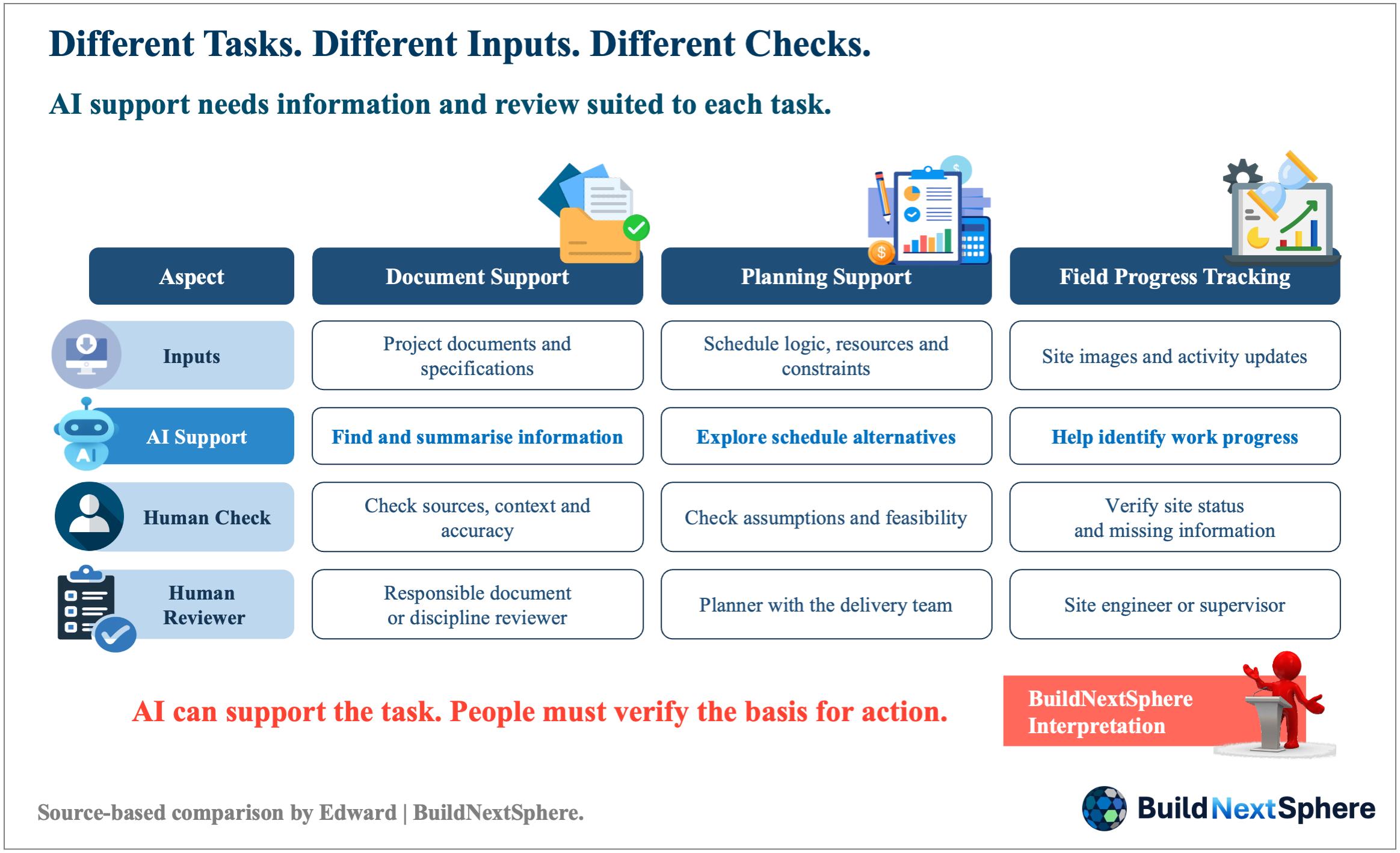
– Figure 02. Different Tasks. Different Inputs. Different Checks.
– Note: Illustrative comparison of AI support functions—not a product ranking or proof of project outcomes. Reviewer roles vary by project.
– Source: Comparison prepared and adapted by Edward | BuildNextSphere, based on Autodesk (2025), ALICE (2024), Buildots (2024) and NIST (2024). See Sources below.
03. Why Field Coordination Is a Different Challenge
Consider a crew preparing to begin an activity. The drawing may be current, but the preceding task may be incomplete. Equipment may be allocated elsewhere, an inspection may be outstanding or access may have changed. The problem is not necessarily a shortage of documents. It may be that several conditions must be confirmed together.
Digital support already reaches the field. Buildots’ July 2024 announcement described combining automated progress tracking with tasks recorded and verified by people. Hong Kong’s 2025 Digital Works Supervision System circular also sets out digital workflows for specified public-works contracts. These examples challenge the idea that field management has no digital systems. Buildots announcement; Development Bureau.
The practical question is how well a system fits a particular project. Someone must provide timely updates, resolve conflicting information and act when a dependency changes. A progress record may describe an activity accurately without confirming that the next activity is ready. Teams need to define that distinction rather than leave it to software terminology.
In the projects I have experienced, master schedules and daily coordination have often operated through different channels. A schedule can show when work is planned, a spreadsheet can track resource allocations, and a message can communicate a change in site conditions. Each serves a purpose. The difficulty arises when these sources do not provide a consistent picture of the same activity—its location, who is responsible and whether it is ready to proceed.
04. A Field Lesson: Connecting Work, Information and Resources
On a large overseas underground construction project, I encountered this coordination problem at a scale that challenged our existing arrangements. Multiple work areas, equipment and teams were involved in interdependent activities. Underground communication constraints made it especially important to reconsider how information travelled between the field and the control room.
I contributed to developing and implementing a mobile work-management system linked to control-room coordination. Its approach included schedule-logic calculations, field updates and work instructions. The wireless network also supported underground communication and equipment-location information. These were connected elements of an operating arrangement, rather than a single screen intended to solve everything.
The important change, from my perspective, was bringing work information and coordination closer together. A system could help show work status and coordination needs, but the information still had to be updated and interpreted by the people doing and managing the work.
That distinction also changed the way I thought about a control room. Its value was not simply the ability to display more information. It was the opportunity to support coordination across work areas, provided that people shared an understanding of the information and knew how to respond when plans and conditions diverged.
I observed improvements in coordination and resource use, but this article does not present a controlled evaluation or measured percentage gains. It also does not describe the historical system as AI. Its relevance is more basic: it showed me why connectivity, usable information and operational responsibility matter before more advanced assistance can become useful.
The account is intentionally anonymous. Location, dates, capacity and contractual details are omitted. Its lesson should be tested against another project’s circumstances, not treated as a ready-made system specification. A different site may face a different bottleneck and need a simpler response.
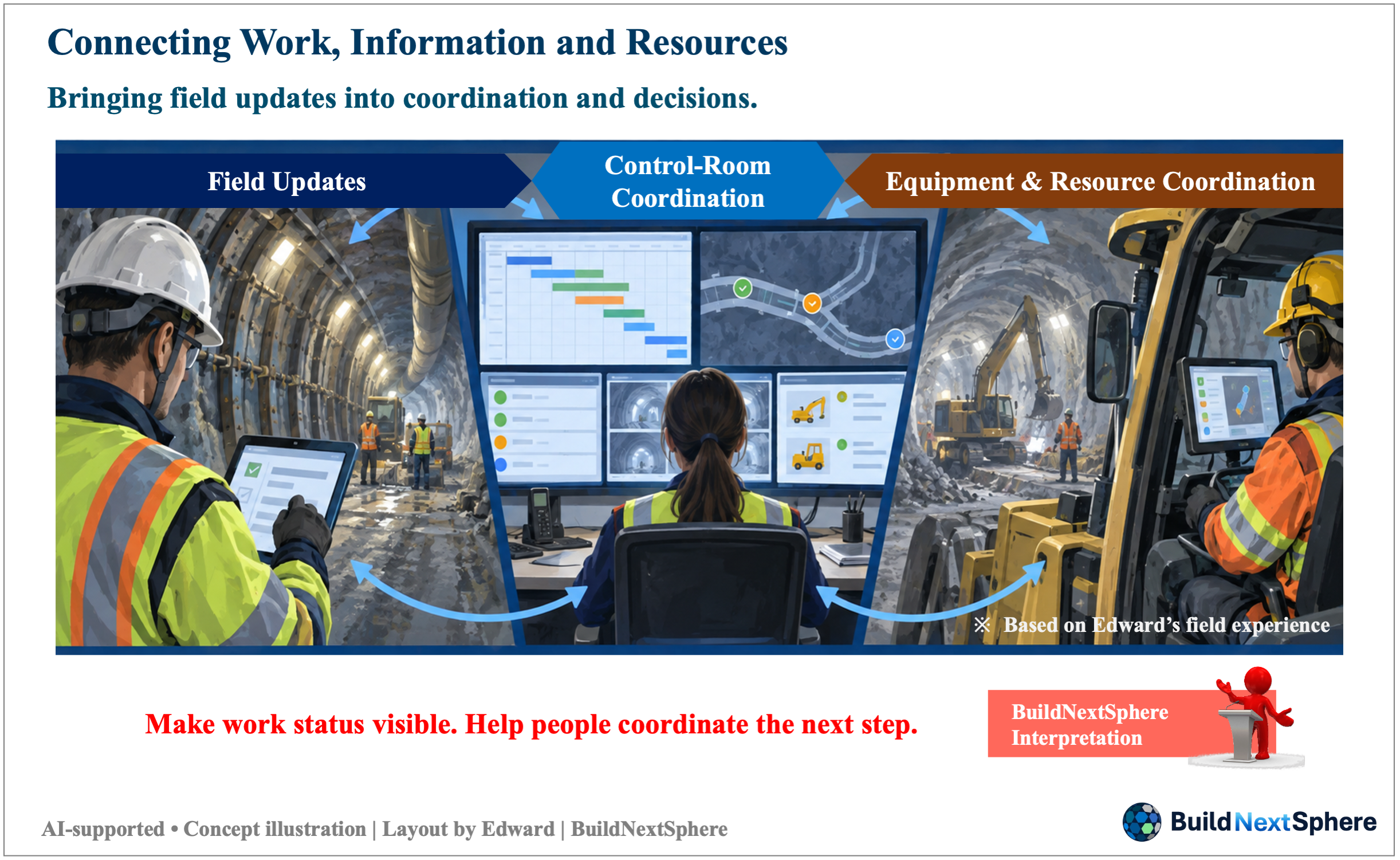
– Figure 03. Connecting Work, Information and Resources.
– Note: The scene illustrates an anonymous field account. It does not depict the actual project or demonstrate measured AI performance.
– Source: AI-generated concept illustration based on Edward’s field experience; layout and text by Edward | BuildNextSphere.
05. Adoption Is Part of the Technology
Introducing the system also revealed resistance, training needs and the effort required to stabilise a new way of working. A technically capable tool did not remove those tasks. People needed to understand why they were being asked to change and how the new arrangement would help them perform their own responsibilities.
RICS’ 2025 survey offers wider context. Among more than 2,200 respondents, the reported barriers included skills shortages (46%), integration with existing systems (37%) and data quality and availability (30%). Respondents could select three barriers. These are reported perceptions, not measured causes of project failure; 48% of responses came from the UK. Source: RICS.
For me, the practical implication is to treat adoption as part of the design. Ask what users must enter, who helps when something fails and which existing steps can be removed. Leadership support matters, but it should be accompanied by training, clear responsibilities and a way for users to report problems.
A workflow that adds another reporting obligation without helping decisions may struggle to earn trust. The aim should be to make necessary work easier to coordinate, not simply to increase the volume of information collected.
06. Start with a Work Problem, Then Test the Tool
Start with a specific recurring problem. For example, a team may repeatedly discover equipment conflicts only when work is about to begin. Define what is happening now, who is affected and what a better outcome would look like. This creates a basis for choosing a response instead of beginning with a product demonstration.
Next, identify the minimum information and responsibility needed. A useful record might include the work area, activity, equipment requirement, expected availability and person authorised to resolve a conflict. Decide how updates are confirmed and what happens when information is missing. Some problems may need a clearer procedure before they need AI.
Test the proposed workflow in a limited area. Compare it with a recorded baseline using measures relevant to the problem: coordination time, waiting, correction effort, missing updates or user burden. Include quality and safety checks. A faster output is not a successful result if reviewers must spend more time repairing it.
Keep the trial small enough that participants can explain what changed. If training, staffing and work scope all change at once, it becomes harder to attribute an improvement to the tool. Record those differences instead of presenting every positive result as a technology benefit. The record is useful even when the trial does not justify expansion.
For AI-supported steps, specify who reviews the output and who can authorise action. Also establish an alternative when the system is unavailable or its answer cannot be trusted. The trial should reveal limitations as well as advantages, with the decision to expand based on evidence from the intended setting.
This is the direction I want to explore through BNS Project Intelligence Sphere Platform concept: connecting field information with preparation, coordination and responsible decisions. It is a development direction informed by experience, not a claim that a complete platform has already demonstrated these outcomes.
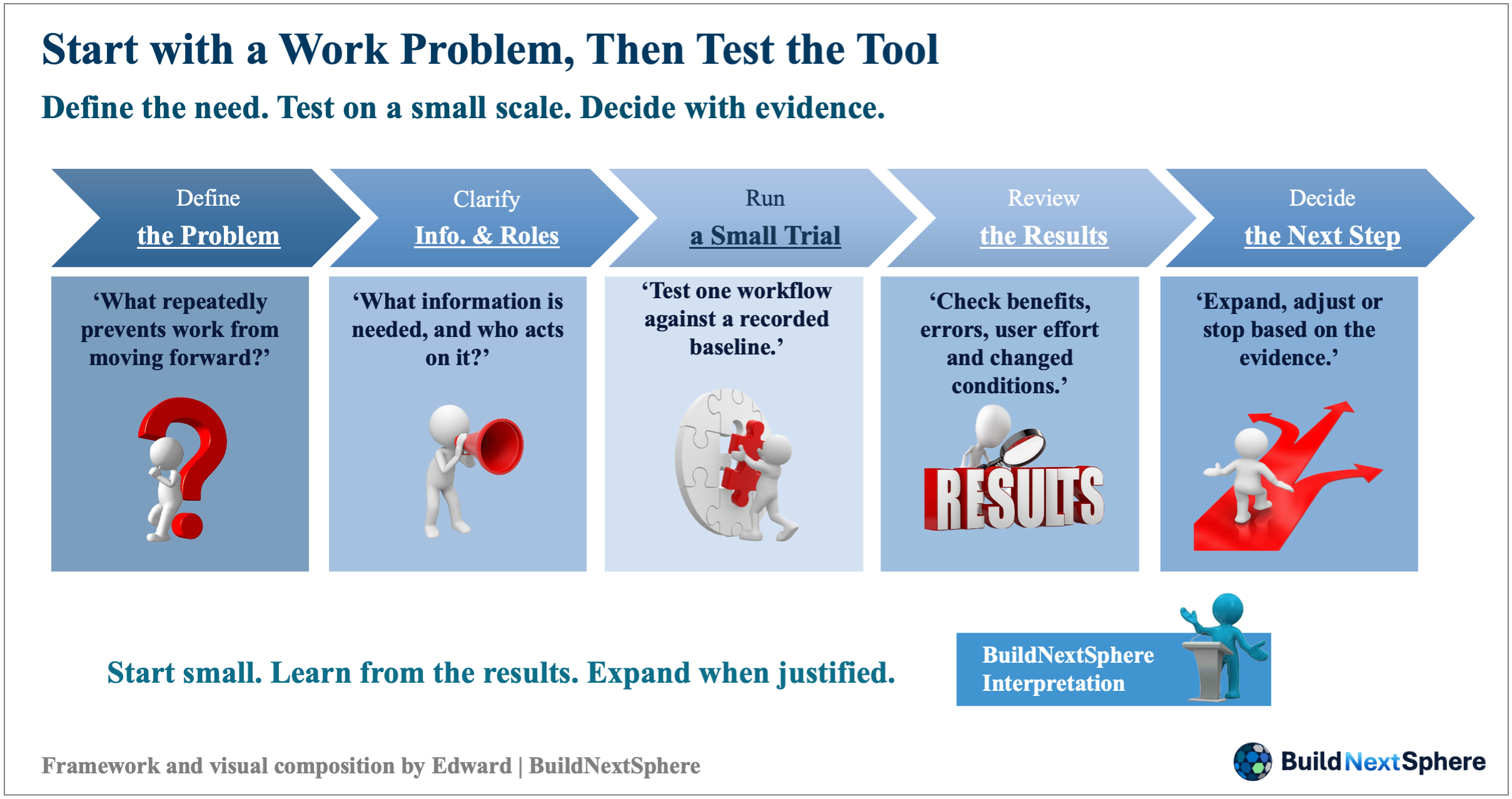
– Figure 04. Start with a Work Problem, Then Test the Tool.
– Note: Illustrative guidance. Adapt the trial scope, measures and responsibilities to the project. Results may support expansion, adjustment or stopping.
– Source: Framework developed by Edward for BuildNextSphere, based on the discussion in Section 06.
07. Which Condition Would Make Your Next Tool Useful?
The future of construction will not be explained by a list of technologies alone. Different projects need different combinations of information, tools and human support. A useful starting question is whether the proposed change helps the people responsible for the work recognise a problem and respond to it.
For your next project, identify one condition that prevents a promising tool from being useful. It might be unreliable updates, unclear authority, poor connectivity or an unnecessary reporting step. Naming that condition turns a broad discussion about transformation into something a team can investigate and improve.
Through BuildNextSphere, I explore these connections between people, technology and project execution. The aim is to learn where assistance is valuable, where judgement remains necessary and what must change around a tool for it to support the work.
Better tools become useful when they help people move the work forward.
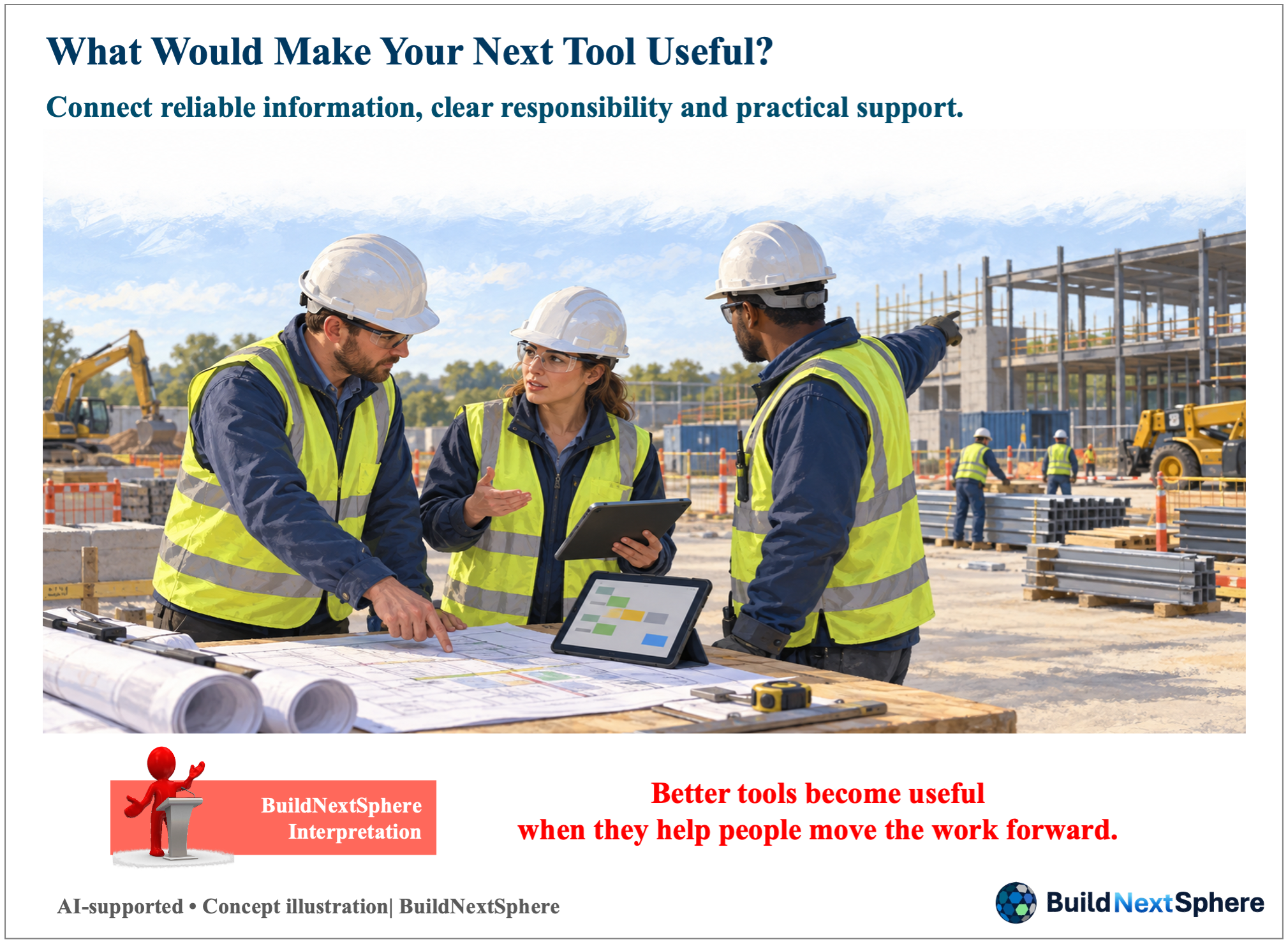
– Figure 05. Connecting People, Information and Tools to Move Work Forward.
– Source: AI-generated concept illustration; layout and text by Edward | BuildNextSphere.
Sources
- RICS — AI in construction report 2025
- Autodesk — Assistant introduction, 18 March 2025
- ALICE — Scheduling optioneering, 25 February 2024
- Buildots — Integrated Tracking announcement, 31 July 2024
- Hong Kong Development Bureau — TC(W) 8/2025, 12 December 2025
- NIST — Generative AI Profile, July 2024
Basis of This Article
This article combines cited surveys, institutional guidance and supplier announcements with Edward Kim’s practical perspective on construction technology. Supplier descriptions indicate reported capabilities, not independently demonstrated project-wide gains; survey findings should be read within their stated scope.
The anonymous work-management account draws on Edward’s direct experience. It is not an independently evaluated performance study, and the historical system is not presented as AI. The proposed selection and trial approach requires review against the intended work, data, users and project conditions.
Related Reading
Explore more from BuildNextSphere:
- Why Doesn’t Better Technology Always Deliver Better Construction Results?
- Why Do Some Countries Advance While Others Miss Opportunities?
- When Projects Don’t Go to Plan: What Are We Missing?
- Between the Plan and the Site: How Can AI Support Project Execution?
BuildNextSphere
BuildNextSphere connects Development, Technology & Project Intelligence through practical, experience-informed content.
About the Author
Edward Kim is the Founder of BuildNextSphere.
He draws on his experience with overseas construction projects to share practical insights from field operations, project delivery, and IT-enabled working systems. Through BuildNextSphere, he explores how people, technology, and real project conditions can help turn plans into action and support better project outcomes.
Content & IP Notice
This article and related materials are prepared and published by BuildNextSphere. Unless otherwise stated, the original structure, wording, diagrams, frameworks, and visual materials are the intellectual property of BuildNextSphere and Edward Kim.
BuildNextSphere, its logo, tagline, and brand assets are part of the BuildNextSphere brand identity. Unauthorized reproduction, modification, redistribution, or commercial use is not permitted without prior written consent.
Third-party names, technologies, or references are mentioned for informational purposes only and remain the property of their respective owners.
5 Responses