
The Indicators Look Healthy. Why Is the Project Still at Risk?
Read summary metrics alongside schedule paths, source records and the next required check.

Source: AI-generated concept illustration; layout and editorial direction by Edward Kim | BuildNextSphere.
Note: Illustrative contrast only; no real performance indicator or structural safety conclusion is shown.
A healthy summary can hide a fragile path
Edward recalls a project where a favourable schedule performance indicator did not remove concern about the critical path and available float. The number and the path were answering different questions. A summary could look reassuring while the sequence controlling completion became less resilient. This was a reason to investigate, not a reason to discard measurement.
An SPI above one can coexist with critical activities behind schedule. DOE’s project-management guidance explicitly pairs SPI with total float and warns against using earned-value schedule measures without network-schedule analysis. The practical lesson is to examine the controlling and near-critical work, not infer the completion outlook from one aggregate ratio. DOE Project Management News, February 2022, p. 4

Source: AI-generated concept illustration; layout and editorial direction by Edward Kim | BuildNextSphere.
Note: The incomplete connection symbolises schedule dependency, not a calculated critical path.
A report can differ from the field
On a different project, Edward encountered a mismatch between reporting and actual conditions. This is a separate experience, not another detail of the first case. A measure can be valid but insufficient for the decision; alternatively, the underlying report may be incomplete, outdated or inconsistent. The two problems call for different checks.
A discrepancy does not establish intent. Access limitations, unclear update responsibility, inconsistent definitions and incorrect reporting all deserve examination without assuming one cause in advance. The proposed response is traceability: preserve the source, the time observed, the time updated and the person responsible for confirmation. Replacing a report with a dashboard does not, by itself, solve its evidence problem.
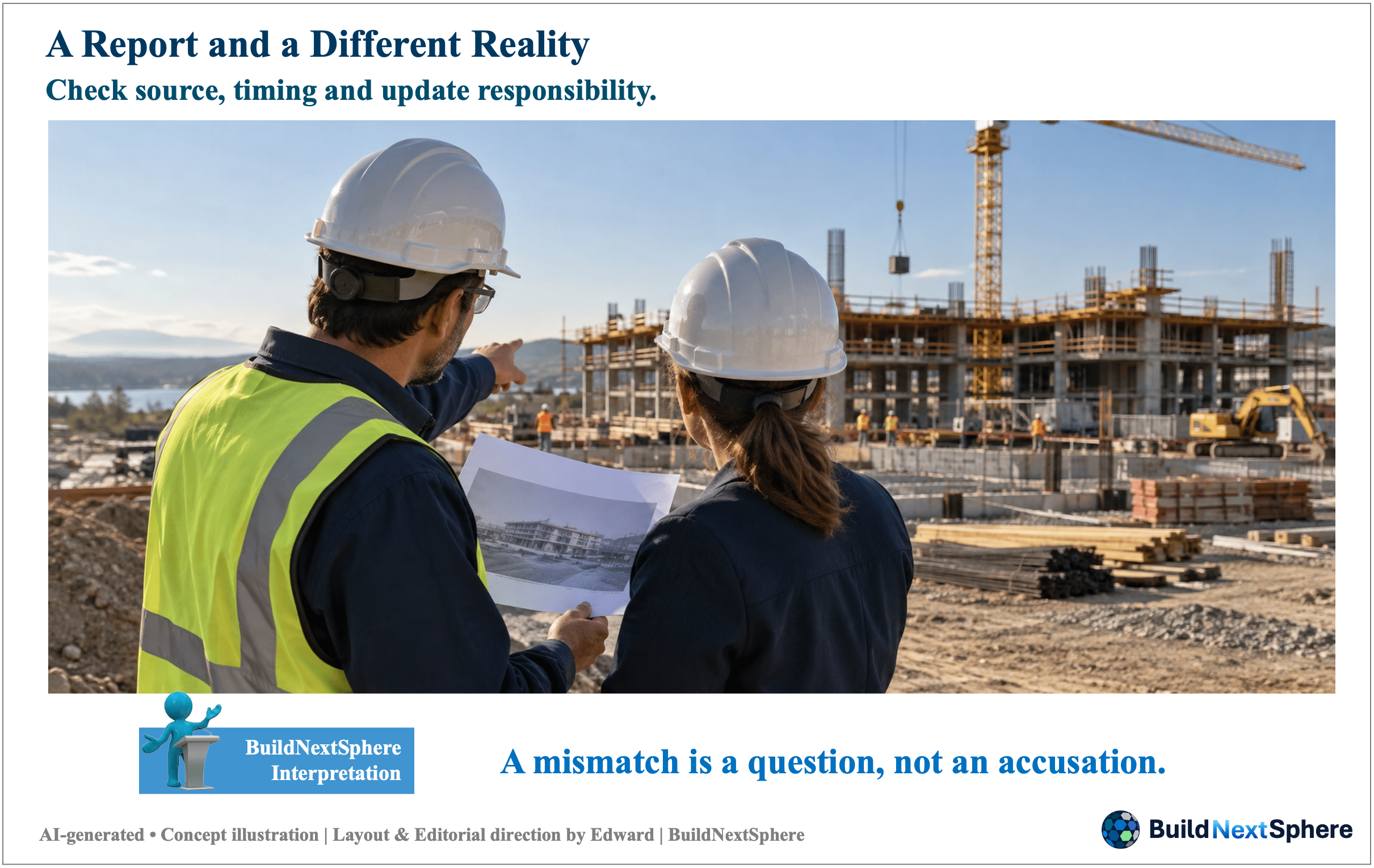
Source: AI-generated concept illustration; layout and editorial direction by Edward Kim | BuildNextSphere.
Note: Conceptual discrepancy review; separate from the indicator example and not evidence of deliberate misreporting.
Check the signal before colouring the dashboard
EWI should connect a signal to the work it may affect. Which activity or commitment is exposed? What changed since the last review? Is the concern based on a verified fact, a forecast assumption or an unconfirmed message? These distinctions matter more than the colour used to display the warning.
PCI develops the schedule and cost outlook; EWI helps organise what needs checking and how urgently. Relevant field changes from WEI and resource or supply information from RPI and PSI can provide context. DKI preserves supporting records. Access should follow responsibilities: making the basis visible to an authorised reviewer is not the same as making all project information public.

Source: AI-generated concept illustration; layout and editorial direction by Edward Kim | BuildNextSphere.
Note: Objects symbolise source and timing checks; no risk score or event probability is represented.
Separate rule-based flags from AI interpretation
Some flags can use explicit rules: a required confirmation is overdue, a source has not been refreshed or a recorded issue remains open beyond its review date. Even these rules need agreed definitions and sensible exceptions. Otherwise, the system may create a large queue of notifications without helping anyone decide what matters.
Interpreting several weak or conflicting signals is a different task. Future AI support could identify combinations worth investigating or compare possible effects and responses. It would require testing for missed warnings, unnecessary warnings and the quality of its explanations. No prediction accuracy, universal threshold or ability to detect every risk is established by the historical reporting experience.

Source: AI-generated concept illustration; layout and editorial direction by Edward Kim | BuildNextSphere.
Note: The review scene illustrates the distinction between explicit rule checks and contextual interpretation. The document trays are not labelled alert categories, and no deployed AI warning system is shown.
Build a signal-review card
For one warning, prepare a signal-review card: the signal; source and timing; confidence and missing information; the possible effect; the checking owner and deadline; and the response or resolution criterion. Keep observed facts and impact hypotheses in separate fields. A plausible consequence should not be displayed as something that has already happened.
The card should support action under uncertainty rather than demand perfect information before anything moves. A serious concern may need prompt escalation with the missing evidence clearly stated. The responsible person decides the appropriate response under the project’s authority and procedures. Recording uncertainty is useful only if it helps identify the next check or decision.

Source: AI-generated concept illustration; layout and editorial direction by Edward Kim | BuildNextSphere.
Note: Proposed signal-review handoff; no universal escalation threshold or fixed approval route.
Move from a warning to a responsible response
A warning is not yet a management decision, a contractual notice or evidence that work should automatically stop. Confirmed concerns may require local coordination through WEI, further forecast analysis through PCI, contract review through CCI or management support through MRI. Not every alert belongs with senior management, and not every concern needs the same response.
After action, revisit the evidence and remaining exposure. An alert being closed is an administrative state, not proof that the project has recovered. Start with one reassuring metric or troubling warning on your project: can you find its source, the work it affects and the person who will check it next? EWI’s proposed value lies in making that connection dependable.

Source: AI-generated concept illustration; layout and editorial direction by Edward Kim | BuildNextSphere.
Note: Conceptual follow-up; no verified recovery, automatic work stoppage or successful intervention is implied.
Sources
U.S. Department of Energy — Project Management News, February 2022, p. 4. Background for the relationship between indicators, total float and critical paths. Checked 5 October 2026; link rechecked 6 October 2026.
Basis of This Article
Two separate project experiences inform the discussion: an insufficiently reassuring schedule summary and a mismatch between reporting and field conditions. DOE guidance supports the narrow technical point about indicators and schedule paths. The EWI review card, routing and AI support are proposed capabilities, not validated prediction performance.
Related Reading
Explore more from BuildNextSphere:
• When Projects Don’t Go to Plan: What Are We Missing?
• Why Do Projects Fail to Execute the Plan?
• Between the Plan and the Site: How Can AI Support Project Execution?
BuildNextSphere
BuildNextSphere connects Development, Technology & Project Intelligence through practical, experience-informed content.
About the Author
Edward Kim is the Founder of BuildNextSphere. He draws on his experience with overseas construction projects to share practical insights from field operations, project delivery, and IT-enabled working systems. Through BuildNextSphere, he explores how people, technology, and real project conditions can help turn plans into action and support better project outcomes.
Content & IP Notice
This article and related materials are prepared by BuildNextSphere. Unless otherwise stated, the original structure, wording, diagrams and visual materials are the intellectual property of BuildNextSphere and Edward Kim. BuildNextSphere, its logo, tagline and brand assets are part of the BuildNextSphere brand identity. Unauthorised reproduction, modification, redistribution or commercial use is not permitted without prior written consent. Third-party names, technologies and references remain the property of their respective owners. General management principles are not claimed as proprietary inventions.