
Is This Work in Scope—or Does It Need Change Review?
Connect contract requirements and field events to timely review, notices and traceable decisions.

Source: AI-generated concept illustration; layout and editorial direction by Edward Kim | BuildNextSphere.
Note: Concept inspired by a missed change review; not evidence of entitlement or a reconstruction of a particular instruction.
A scope decision can be missed before a claim begins
A claim can be missed before anyone starts preparing a claim document. On a Kenya education-facility project, Edward encountered an instruction that needed change review but was treated by the responsible person as existing scope. The work was carried out and the matter was not claimed. The failure described here was the missed review and decision, not a proven entitlement that an adjudicator had awarded.
It would be equally wrong to conclude that every item absent from a drawing is additional work. The applicable contract documents need to be examined together. A requirement may sit in another document or depend on the agreed allocation of responsibility. The proposed CCI direction begins with helping the team recognise when a scope question needs qualified attention, before experience or habit becomes an unexamined answer.

Source: AI-generated concept illustration; layout and editorial direction by Edward Kim | BuildNextSphere.
Note: Illustrative reflection on the Kenya account; no award, limitation period or recoverable amount is depicted.
Read the obligation before planning the work
At planning stage, connect the intended work with the applicable agreement, drawings, specifications and relevant instructions. The reviewer should establish which versions apply and where an inconsistency or uncertainty needs resolution. This also addresses the opposite risk: failing to plan an obligation that was present in the governing requirements and discovering it only after work has proceeded.
Document retrieval alone cannot settle that interpretation. As a background example, FIDIC’s 1999 Construction Contract material distinguishes General and Particular Conditions, including amendments and additions. That illustrates why the project-specific contract set matters; it does not establish which form or clause governed Edward’s example. No standard-form deadline or entitlement is assumed here. FIDIC: Construction Contract, 1999 Red Book

Source: AI-generated concept illustration; layout and editorial direction by Edward Kim | BuildNextSphere.
Note: Generic document review; does not identify the governing contract form or document precedence.
Record the event without demanding a legal conclusion
A field engineer should be able to flag a changed condition or instruction without first writing a legal argument. A short factual note can identify what happened, when and where, who issued the instruction and which work is affected. Photographs, contemporaneous records and the original communication can then be linked without changing their meaning.
The proposed system would route this event for review, not label every event a valid claim. Keep the field observation, contract question and reviewer’s conclusion distinguishable. If information is missing, identify the next evidence needed. The purpose is to lower the burden of bringing an issue to attention without lowering the standard of the eventual contractual assessment.

Source: AI-generated concept illustration; layout and editorial direction by Edward Kim | BuildNextSphere.
Note: Hypothetical evidence capture; a photograph or note alone does not establish a claim.
Connect review, notice and follow-up
The review workflow should surface the applicable notice conditions, relevant dates, authorised signatory and intended recipient for human checking. A possible time-sensitive requirement should be visible promptly. Later preparation of a consolidated claim package should not be used as a reason to postpone reviewing individual notice requirements. The actual obligations must be determined from the applicable contract and qualified advice.
Keep registration, draft preparation, approval, submission and receipt as separate states. An internal entry does not prove that a formal communication was issued correctly or received. Likewise, a submitted notice is not a decision that the claim is accepted. Following the event through these distinctions is more useful than a register that treats all open matters as equivalent.

Source: AI-generated concept illustration; layout and editorial direction by Edward Kim | BuildNextSphere.
Note: Separate trays symbolise keeping registration, review and submission distinct; no tray is assigned a specific stage. The image does not show contractual acceptance or a universal notice process.
Use one event-review record
One event-review record can connect six areas: event and instruction; applicable documents and versions; obligation or change question; notice conditions and dates; authority and proposed response; and submission, receipt and follow-up. The record should link schedule and cost evidence where relevant without presenting a calculated impact as an automatic contractual entitlement.
CCI leads the contract-review question. DKI supports records, versions and approval history; PCI supports analysis of schedule and cost effects; WEI receives authorised operational responses. Where the site lacks suitable expertise or authority, MRI can support escalation. This division avoids turning the document store into a legal decision-maker or the schedule engine into an EOT award mechanism.

Source: AI-generated concept illustration; layout and editorial direction by Edward Kim | BuildNextSphere.
Note: Proposed evidence review; no contractual right, EOT or amount has been determined.
Assist the reviewer, retain the authority
Future AI support could retrieve relevant clauses and records, highlight missing information and prepare a review draft. It should show its references and uncertainty. It should not decide entitlement, compensation, extension of time, work suspension or external dispatch. People with the appropriate role must review and authorise those actions under the project’s arrangements.
These are development proposals, not proof of an operating BNS contract module or legal advice on an individual claim. Start with one instruction that changed your planned work. Can the team locate the governing requirement, identify the review owner and see the next time-sensitive action? CCI is intended to make that path harder to miss, not to promise that every change produces a successful claim.
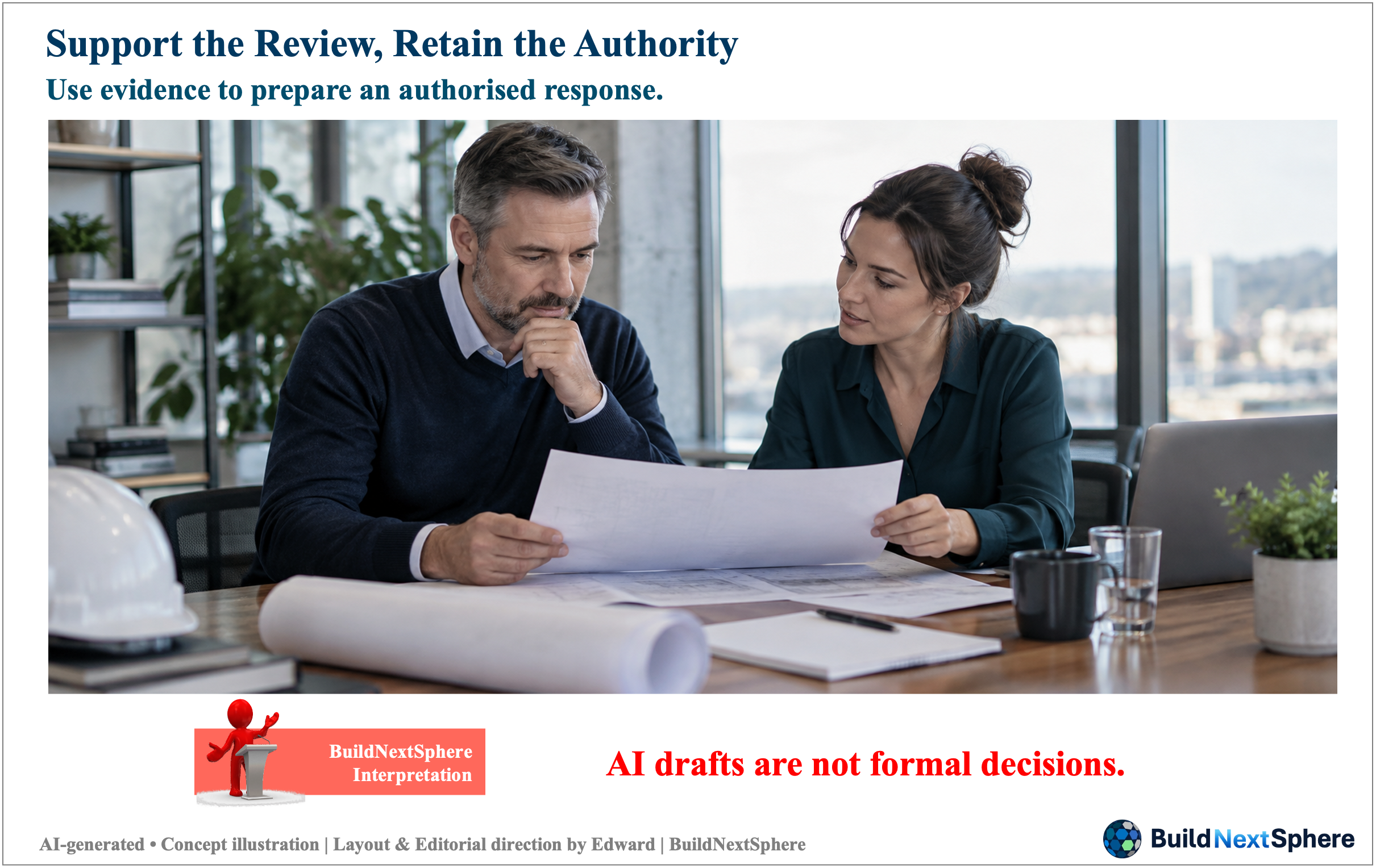
Source: AI-generated concept illustration; layout and editorial direction by Edward Kim | BuildNextSphere.
Note: Future assistance concept only; no automatic legal judgement, signature or external dispatch.
Sources
FIDIC — Construction Contract, 1st Ed. 1999 Red Book. Background on project-specific General and Particular Conditions; not identification of the contract form or governing law in the example. Checked 5 October 2026; link rechecked 6 October 2026.
Basis of This Article
Edward’s Kenya education-facility account concerns a missed change review and a claim not made. It does not establish entitlement, an award or an expired contractual deadline. FIDIC material is background only, not identification of the applicable contract. The proposed workflow is not case-specific legal advice or evidence of an operating BNS claim module.
Related Reading
Explore more from BuildNextSphere:
• Why Do Projects Fail to Execute the Plan?
• When Projects Don’t Go to Plan: What Are We Missing?
• Between the Plan and the Site: How Can AI Support Project Execution?
BuildNextSphere
BuildNextSphere connects Development, Technology & Project Intelligence through practical, experience-informed content.
About the Author
Edward Kim is the Founder of BuildNextSphere. He draws on his experience with overseas construction projects to share practical insights from field operations, project delivery, and IT-enabled working systems. Through BuildNextSphere, he explores how people, technology, and real project conditions can help turn plans into action and support better project outcomes.
Content & IP Notice
This article and related materials are prepared by BuildNextSphere. Unless otherwise stated, the original structure, wording, diagrams and visual materials are the intellectual property of BuildNextSphere and Edward Kim. BuildNextSphere, its logo, tagline and brand assets are part of the BuildNextSphere brand identity. Unauthorised reproduction, modification, redistribution or commercial use is not permitted without prior written consent. Third-party names, technologies and references remain the property of their respective owners. General management principles are not claimed as proprietary inventions.
Professional insight is very impressive.
Looking forward other articles.