
What Evidence Does Management Need to Support a Project?
Turn project concerns into timely decisions, authorised support and checked results.
Source: AI-generated concept illustration; layout and editorial direction by Edward Kim | BuildNextSphere.
Note: Conceptual support review, not an actual executive meeting or authorised decision.
A status report is not a support decision
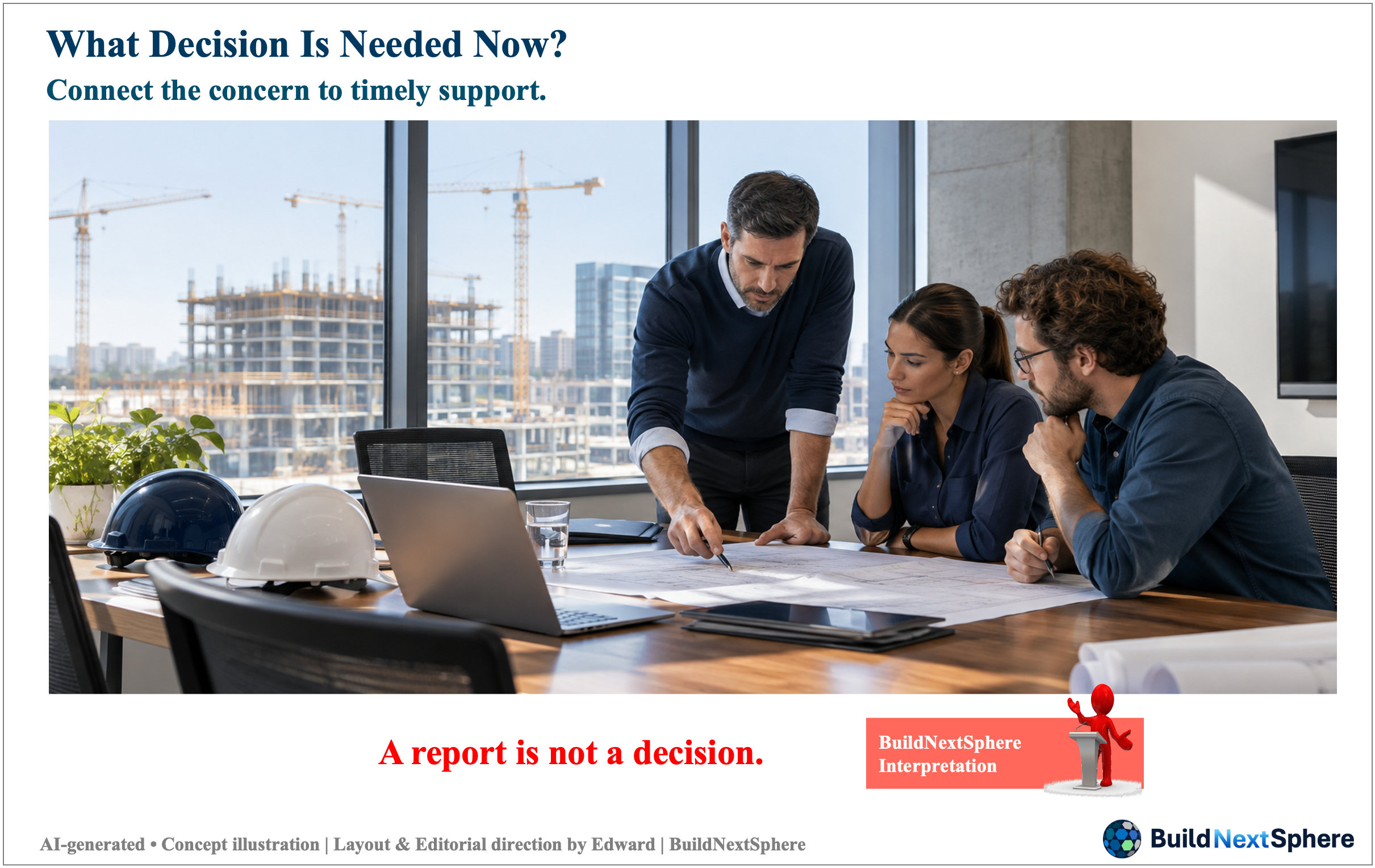
A management report can show a project’s condition without explaining what management needs to decide. More charts do not necessarily clarify whether the site needs additional authority, specialist review, funding or coordination with another project. MRI starts at that gap: what support is needed, by when, on what evidence and within whose authority?
This is different from generating another risk alert. EWI organises the signal and the next check; PCI explains the current outlook and its assumptions. MRI turns the relevant concern into a support decision. The same evidence may be reused, but the question changes from what is happening to what authorised intervention is justified.

Source: AI-generated concept illustration; layout and editorial direction by Edward Kim | BuildNextSphere.
Note: Symbolic comparison of reporting and a decision brief; no real confidential report.
Support can arrive after the useful moment
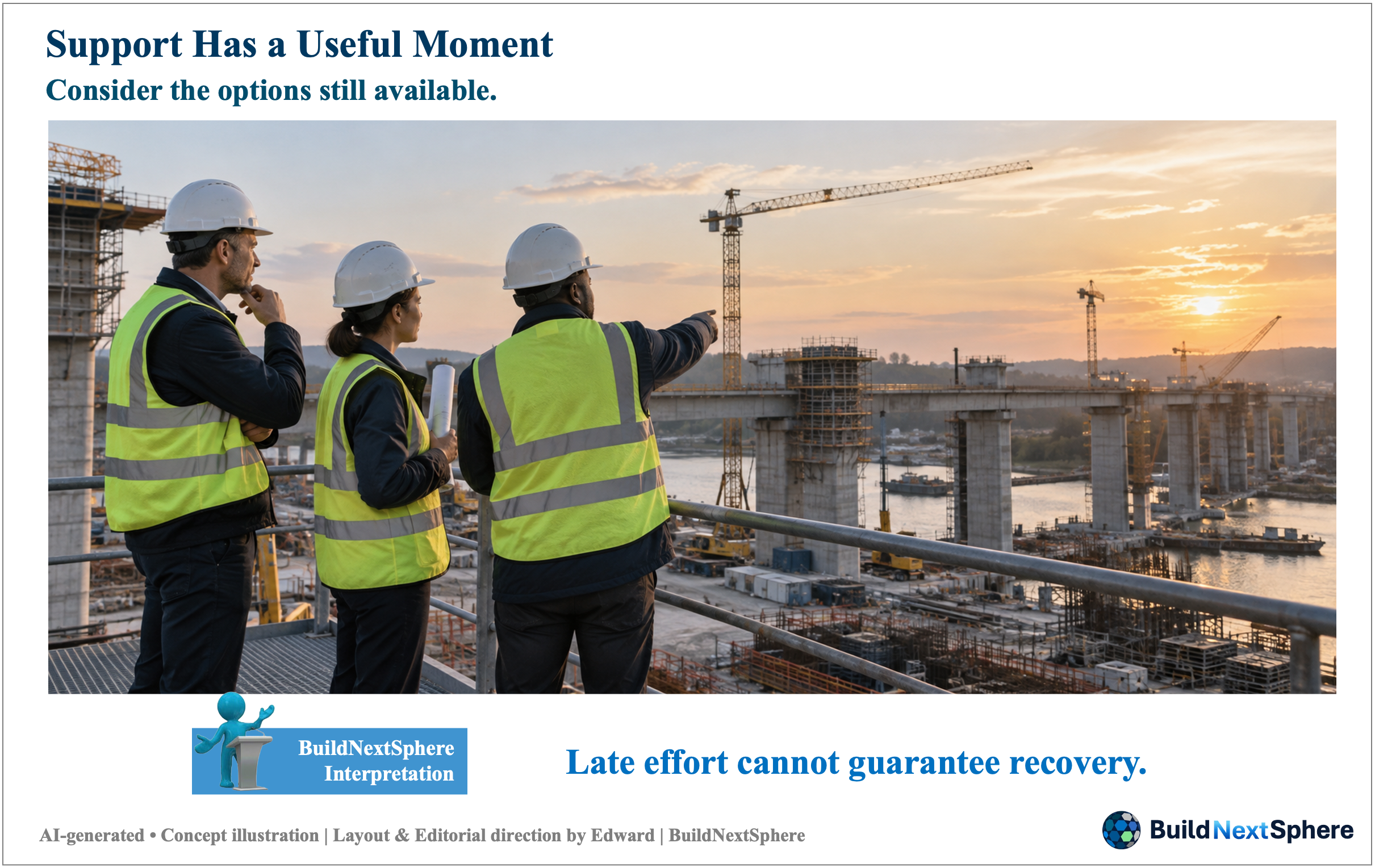
Edward’s field and headquarters experience includes an overseas infrastructure project where the useful timing for intervention was missed. A support team was subsequently deployed, but the intended recovery was not achieved. Additional effort did not reverse the outcome. The public lesson concerns decision timing and the limits of late support, not a disclosed project identity or a reconstructed financial case.
PCI uses this experience to explain why a summary should be checked against its underlying records. MRI asks what happens after a concern becomes visible: can the need reach a person able to decide while useful options remain? The account does not prove that a particular earlier action would certainly have succeeded. It does justify asking about the time available for a decision.
Source: AI-generated concept illustration; layout and editorial direction by Edward Kim | BuildNextSphere.
Note: Inspired by an unsuccessful late-support experience; not a photograph, quantified loss or proof that earlier intervention would succeed.
Separate local action from headquarters support
Not every problem should travel to headquarters. A site team should retain decisions within its delegated authority and capability. Otherwise, escalation becomes another source of delay and weakens local responsibility. The distinction should consider the effect of the issue, urgency, available expertise and the approval needed—not only its colour on a dashboard.
Headquarters support may be appropriate where the response needs resources shared across projects, a budget decision, specialist contract or procurement input, or authority unavailable locally. A proposed MRI workflow would make that boundary visible and route the request accordingly. It would not require senior approval for every routine field adjustment.

Source: AI-generated concept illustration; layout and editorial direction by Edward Kim | BuildNextSphere.
Note: Conceptual separation of local action and support requests, not a mandatory approval chain.
Compare feasible support choices
A useful decision compares feasible choices and the consequences of waiting. PCI may contribute completion and cost scenarios, RPI resource evidence, PSI supply constraints and CCI contract questions. DKI keeps the supporting records traceable. Missing information should stay visible so that an option is not made to look certain by omitting its weak assumptions.
Transferring equipment or expertise may help one project and reduce another’s capacity. Faster delivery may add cost or create a different constraint. Each option needs consideration of time, cost, quality, safety, contract conditions and implementability. AI could later assist comparison, but it cannot establish those trade-offs as acceptable on management’s behalf.

Source: AI-generated concept illustration; layout and editorial direction by Edward Kim | BuildNextSphere.
Note: Models symbolise cross-project trade-offs; no validated optimisation or transfer recommendation.
Prepare one decision brief
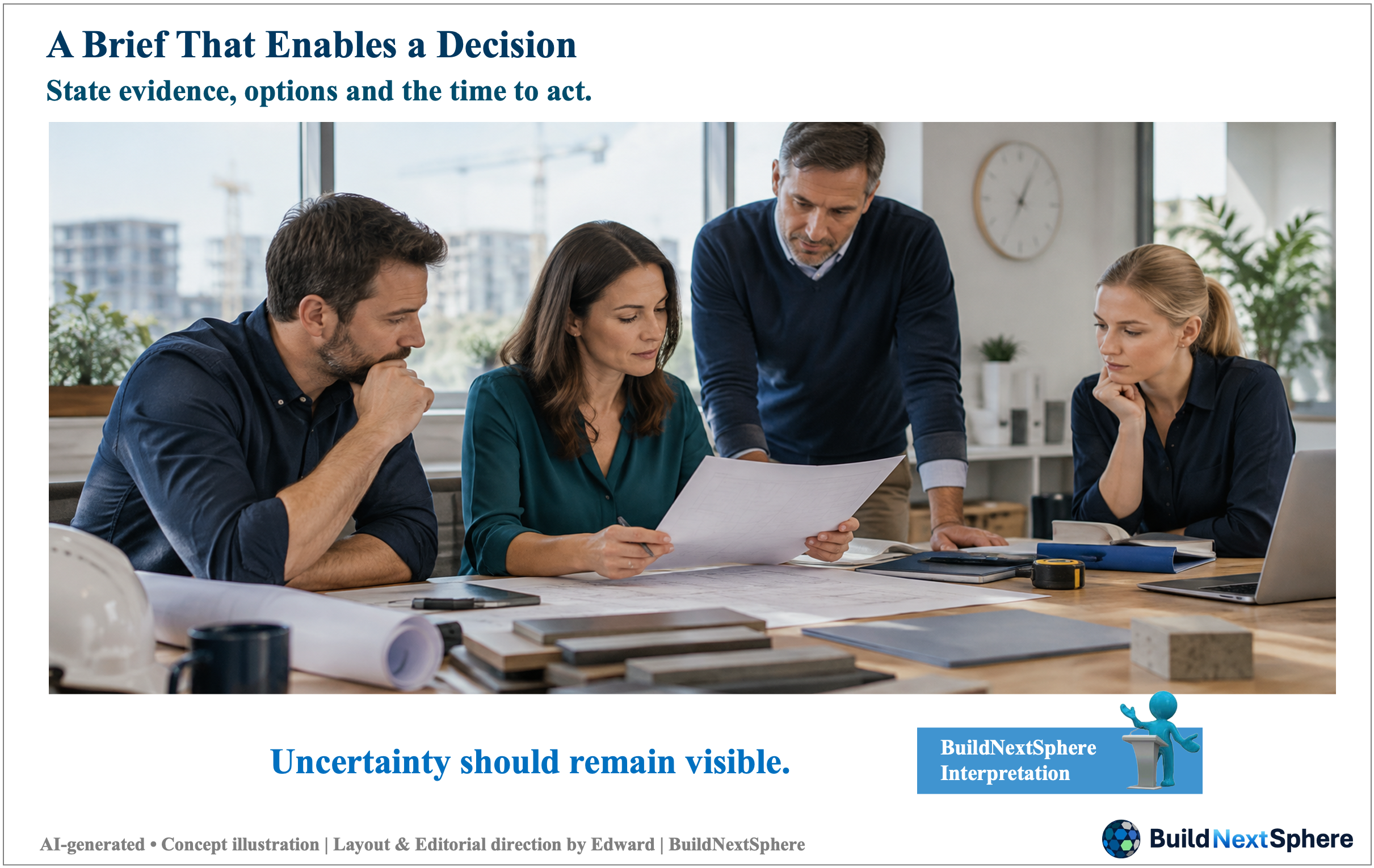
Prepare one decision brief with six parts: confirmed concern and remaining uncertainty; impact and decision deadline; limits of the local response; feasible options and wider consequences; approval authority and delivery owner; and execution checks with remaining risk. State the decision requested near the beginning. An executive should not have to infer it from a long collection of attachments.
The brief is a proposed working aid, not a rigid approval chain. If further checks can be completed within the available time, assign them. If waiting itself is consequential, make the urgency and uncertainty explicit for the authorised decision-maker. Record which assumptions were accepted and when the decision should be revisited.
Source: AI-generated concept illustration; layout and editorial direction by Edward Kim | BuildNextSphere.
Note: Proposed decision-brief concept; no fixed management threshold or guarantee of outcome.
Return the decision to execution
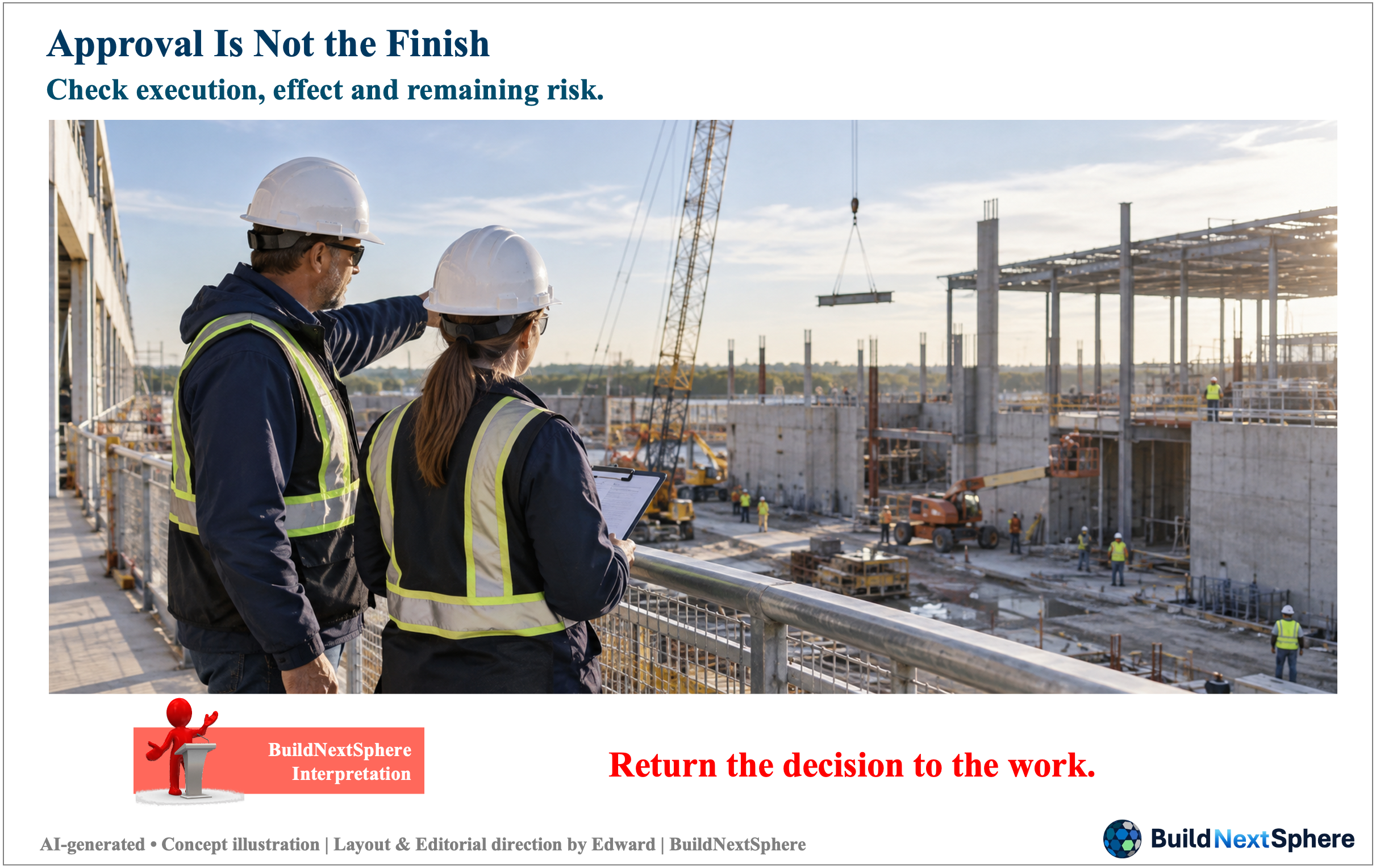
An approved support decision must return to the operating plan. WEI can carry the authorised task adjustment; procurement or resource teams act within their approved remit; PCI updates the relevant forecast. The owner then checks whether the support arrived, whether it was used and whether the expected effect occurred. Issuing approval is not the end of the loop.
The remaining risk may require another decision even after the agreed action is complete. That feedback is central to MRI’s proposed role. BNS PIS remains a development direction, not a released management platform or a guarantee of recovery. Look at one current request for headquarters support: is the required decision clear, is there still time to act, and will anyone verify the result? Those connections are the starting point.
Source: AI-generated concept illustration; layout and editorial direction by Edward Kim | BuildNextSphere.
Note: Conceptual follow-up after support; not evidence of a successful recovery or completed PIS platform.
Sources
No external sources cited. The experience account is based on Edward Kim’s direct project experience and subsequent clarifications.
Basis of This Article
The management-support account is Edward’s anonymised overseas infrastructure experience, including unsuccessful late recovery support. No hypothetical earlier action is claimed to have guaranteed success. The decision brief and PIS connections are proposals, not a released platform or measured recovery outcome.
Related Reading
Explore more from BuildNextSphere:
• When Projects Don’t Go to Plan: What Are We Missing?
• Between the Plan and the Site: How Can AI Support Project Execution?
• Why Do Projects Fail to Execute the Plan?
BuildNextSphere
BuildNextSphere connects Development, Technology & Project Intelligence through practical, experience-informed content.
About the Author
Edward Kim is the Founder of BuildNextSphere. He draws on his experience with overseas construction projects to share practical insights from field operations, project delivery, and IT-enabled working systems. Through BuildNextSphere, he explores how people, technology, and real project conditions can help turn plans into action and support better project outcomes.
Content & IP Notice
This article and related materials are prepared by BuildNextSphere. Unless otherwise stated, the original structure, wording, diagrams and visual materials are the intellectual property of BuildNextSphere and Edward Kim. BuildNextSphere, its logo, tagline and brand assets are part of the BuildNextSphere brand identity. Unauthorised reproduction, modification, redistribution or commercial use is not permitted without prior written consent. Third-party names, technologies and references remain the property of their respective owners. General management principles are not claimed as proprietary inventions.