
Why Do Some Countries Advance While Others Miss Opportunities?
South Korea’s economic development offers a starting point for exploring how infrastructure, skills and practical execution can turn opportunities into progress.
By Edward Kim | BuildNextSphere
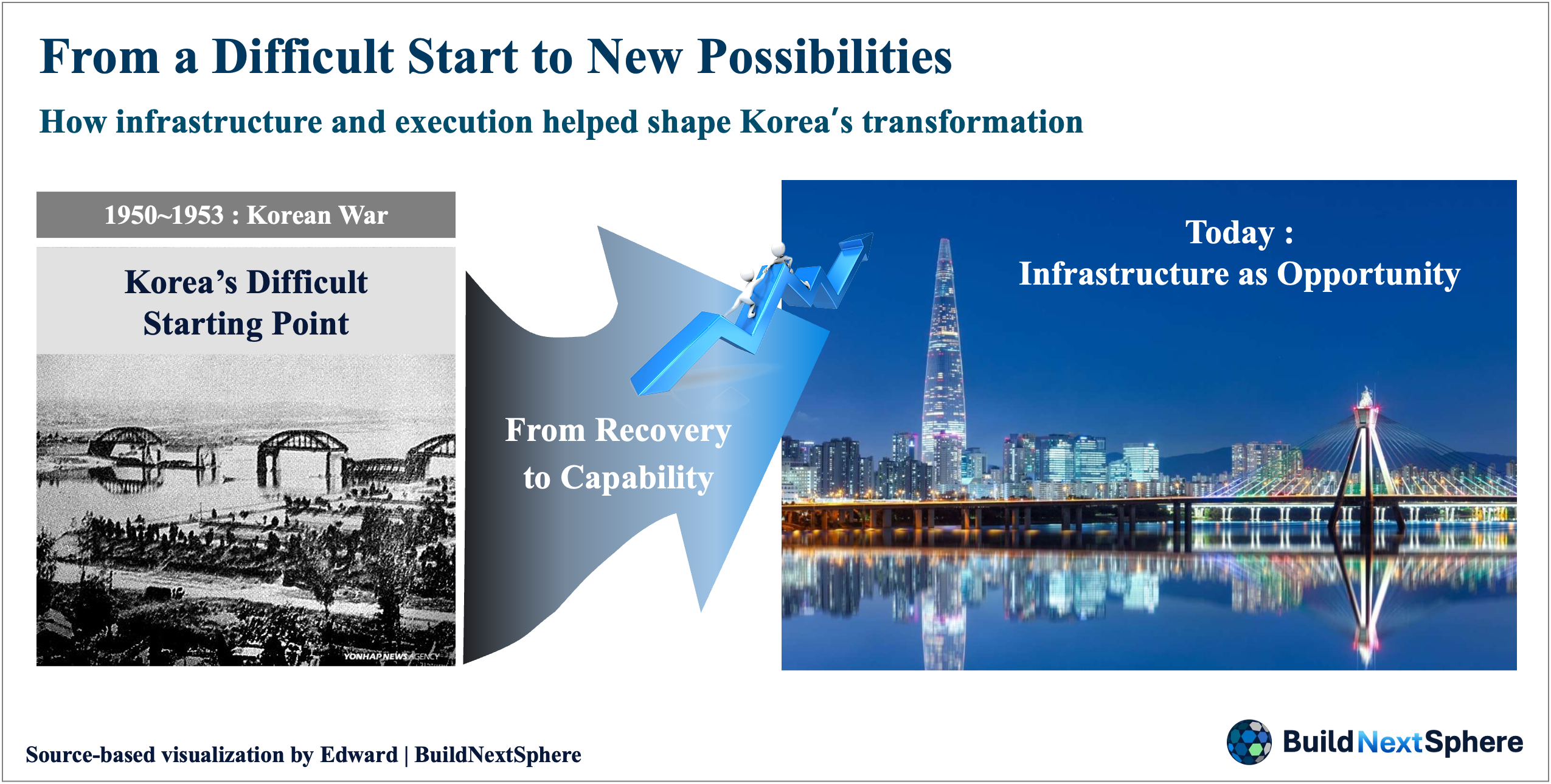
– Figure 1. From a difficult start to new possibilities. A visual comparison of Korea’s difficult starting point and a modern skyline.
– Note: The juxtaposition introduces a development question; it does not explain the causes of Korea’s transformation or depict the same bridge before and after reconstruction.
– Source: Visual composition by Edward | BuildNextSphere.
01. Different Starting Points, Different Outcomes
A damaged bridge and a modern skyline can tell a powerful story. One shows the difficulty of rebuilding; the other suggests connections, investment and new possibilities. Yet the distance between those two images contains the harder question: what allowed change to happen?
South Korea’s transformation invites that question. In the World Bank’s historical series, GDP per capita in 1960 was approximately $159 in South Korea, compared with $175 in Ghana, $241 in Malaysia, $269 in the Philippines, and $103 each in Thailand and Kenya. By 2024, the figures had reached approximately $36,239, $2,419, $11,874, $3,985, $7,387 and $2,133, respectively, in current US dollars. The chart below traces the six countries’ GDP per capita from 1960 to 2025, showing how their paths diverged over time.
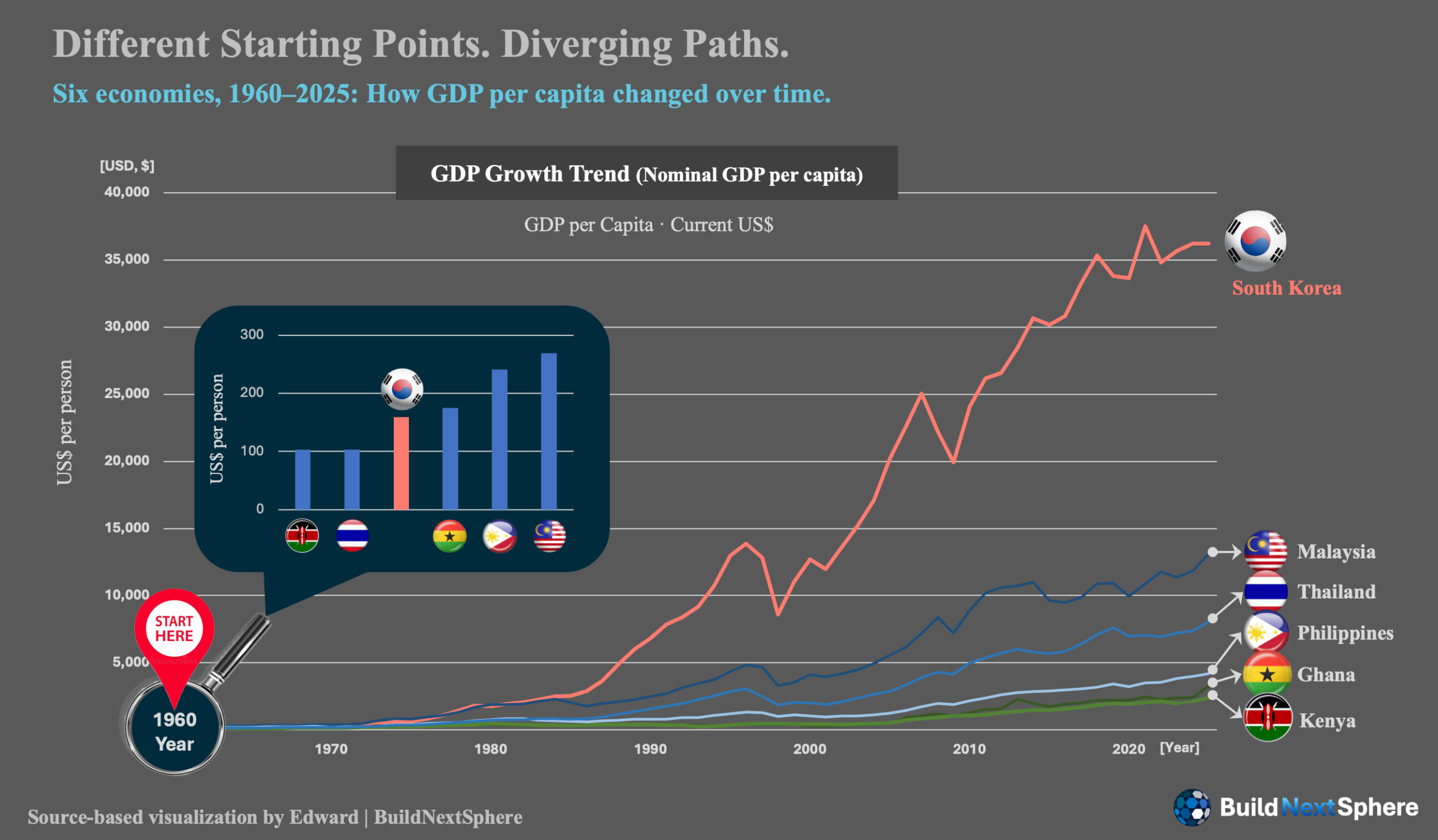
– Figure 2. GDP per capita across six countries, 1960–2025. South Korea, Ghana, Malaysia, the Philippines, Thailand and Kenya, measured in current US dollars.
– Note: Current-dollar values reflect prices and exchange rates, not real growth alone. Selected income comparisons neither capture all starting conditions nor establish causation. The chart extends to 2025; the accompanying prose uses 2024 comparisons.
– Source: World Bank, World Development Indicators — NY.GDP.PCAP.CD. Data access date recorded in the draft: September 13, 2026. Visualization by Edward | BuildNextSphere.
The useful question is what countries can learn from those paths. For infrastructure professionals, that means looking beyond the finished skyline to the institutions, skills and working decisions that helped create it.
These selected comparisons illustrate different development paths. They do not establish that every starting condition was better elsewhere. Current-dollar figures also reflect prices and exchange rates, so the change between dates cannot be read as a measure of real growth. Source: World Bank WDI.
02. South Korea’s Transformation Was Built Over Time
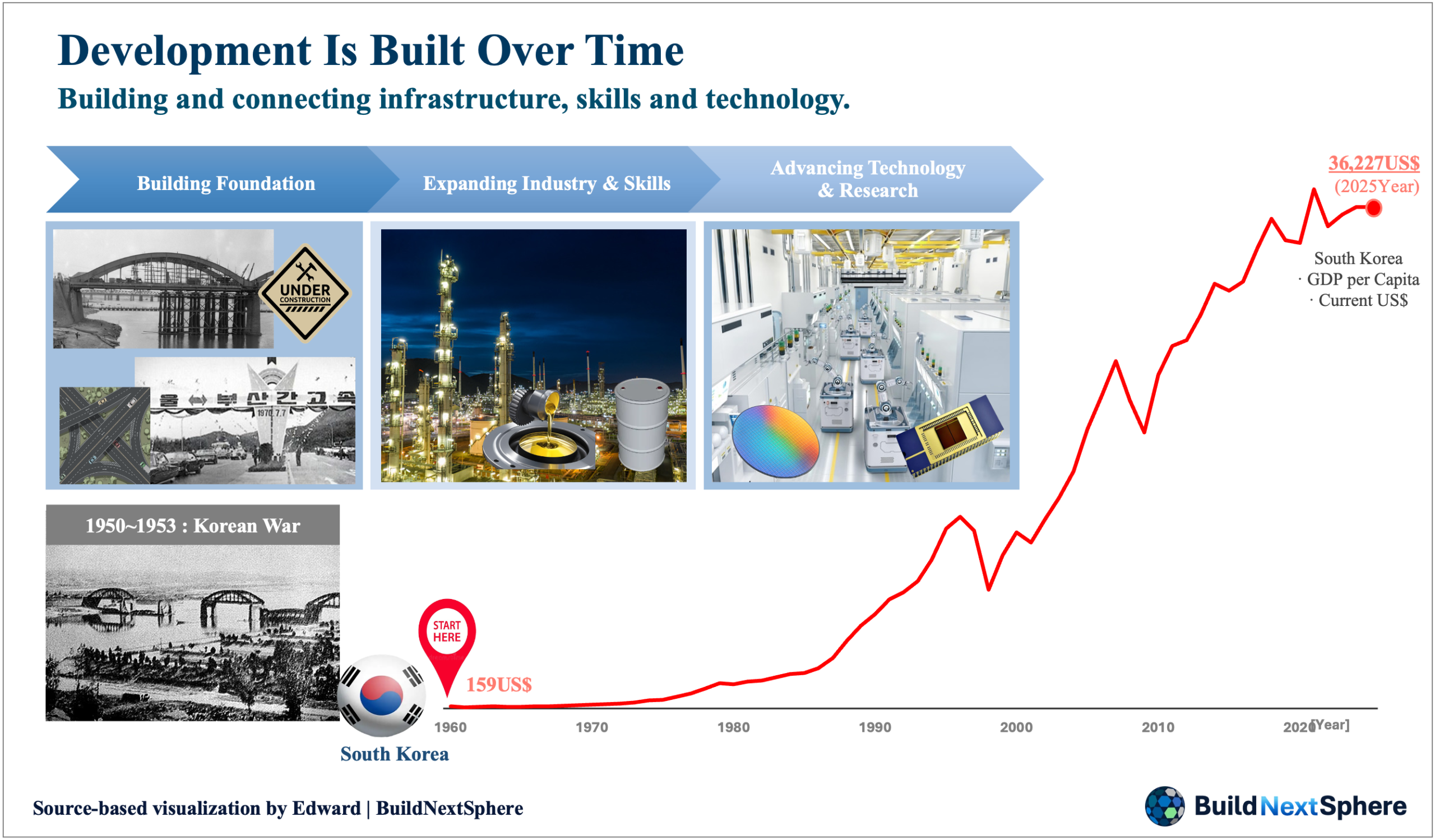
– Figure 3. Development is built over time. Illustrative themes connect infrastructure, industrial capabilities and technology with Korea’s longer-term transformation.
– Note: The development themes overlap and are not a precise periodization. The current-US-dollar GDP curve does not establish the contribution or causal effect of any individual investment.
– Source: World Bank WDI — NY.GDP.PCAP.CD and Republic of Korea overview for data and background. Visual composition by Edward | BuildNextSphere.
Korea’s experience is often compressed into a dramatic before-and-after picture. That is a useful introduction, but an incomplete explanation. The World Bank describes a transformation involving sustained investment in education, infrastructure and technology alongside economic management. Its account of development lending traces a changing focus from early transport and other basic needs toward industrial development, human capital and research. Source: World Bank, Republic of Korea.
This broader perspective matters when discussing infrastructure and economic growth. A road can improve access to markets, but firms also need capabilities and customers. A training institution can provide facilities, but it needs educators, equipment and a programme that meets real needs. The connections deserve as much attention as the individual investments.
For this article, execution capability means the ability to carry an intention through preparation, coordination, delivery and adjustment. It includes recognising when a plan rests on assumptions that no longer fit. This is a practical lens for examining development, rather than a complete explanation of Korea’s economic history.
A country considering lessons from Korea should therefore ask which capabilities it needs to build, in what order and under what conditions. The visible result is an important part of the story. Understanding the work required to sustain that result is more useful than copying its appearance.
03. Infrastructure Creates Opportunities—When It Serves Real Needs
An infrastructure project begins with a proposed asset. Its development purpose lies in the service people can use: a dependable connection, a functioning learning environment or access to essential resources.
Kenya-AIST, located in Konza Technopolis, offers a relevant example of an effort to connect facilities with institutional capability. KAIST’s April 2025 announcement identifies its responsibilities for overall consulting and educational design, alongside Samoo’s architectural design, Sunjin’s construction supervision and Bomi’s construction work. It also identifies EDCF loan support.
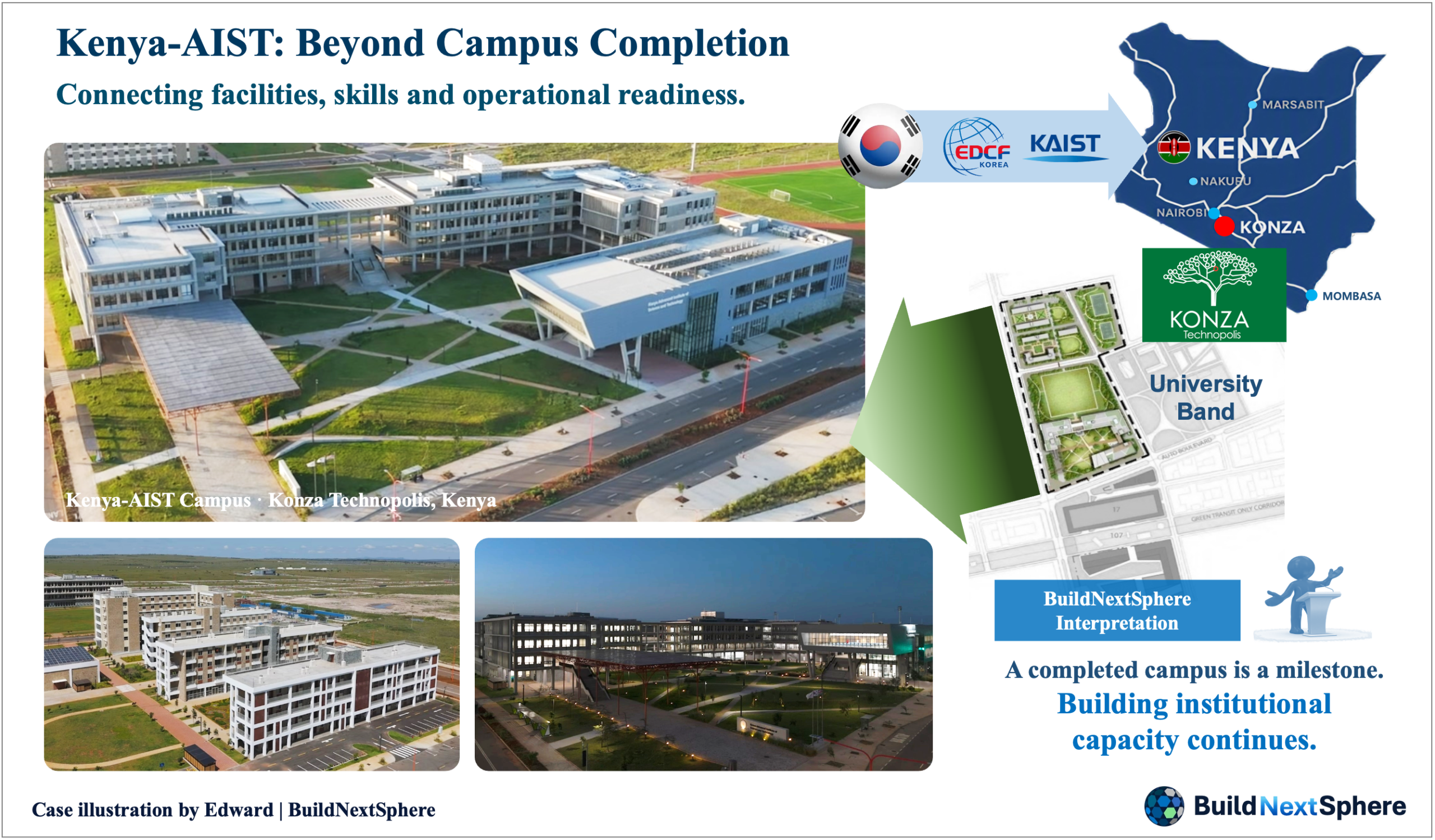
– Figure 4. Kenya-AIST: connecting a campus with institutional capability. Campus views and location context illustrate the relationship between a physical facility and its intended educational purpose.
– Note: The cited announcement distinguishes campus completion from subsequent operating preparations. The images do not establish long-term educational or economic outcomes; the location graphic is illustrative.
– Source: KAIST, April 28, 2025 — Kenya-AIST campus completion. Visual composition by Edward | BuildNextSphere.
The announcement records the campus completion ceremony and subsequent taking-over certificate in April 2025. It describes a following phase involving staff training, administrative preparation and laboratory equipment. The distinction is valuable: completing the campus was a milestone within a wider process of building an institution. Source: KAIST, April 2025.
The available evidence does not establish long-term educational or economic results. It does, however, provide a concrete reason to discuss construction, operating readiness and skills together.
The same question applies to other projects: who will operate the asset, with what resources, and for whose needs? Identifying these conditions during preparation gives delivery teams a clearer purpose. It also creates a basis for checking whether a completed facility is ready to provide the intended service.
04. Execution Turns Development Plans into Results
In the overseas organisations and projects I have worked with, I have valued a strong willingness to finish difficult work, respond quickly and help across departmental boundaries. These are observations from my own experience. They should not be treated as traits shared by every Korean company or worker.
Their practical value depends on how work is organised. A quick response needs reliable information. Responsibility needs sufficient authority and support. Cooperation needs clear roles, particularly when several teams depend on the same access, equipment or approvals.
I have also encountered situations where assumptions made during feasibility work were carried into later design without enough reconsideration. When personnel changed, the reasoning behind earlier decisions could become harder to recover. Drawings might be available while the context needed to assess them was less clear.
For project leaders, this suggests a responsibility to preserve the reasoning behind important choices and revisit it when conditions change. Speed remains useful, but so does the ability to pause a decision that could undermine safety, quality or workable sequencing.
The World Bank’s infrastructure governance framework places institutional arrangements and the performance of infrastructure services within the same discussion. My operational interpretation is to connect those responsibilities to everyday decisions: who checks an assumption, who resolves an obstacle and who confirms readiness? Source: World Bank InfraGov.
05. When Reality Outgrows the Original Plan
On a large overseas underground construction project, I encountered a gap between planning assumptions and the conditions required to perform the work. The project involved multiple work areas and interdependent activities. Ventilation needs and the difficulty of coordinating equipment, people and successive tasks required renewed attention.
I participated directly in developing and implementing an additional ventilation arrangement. I also contributed to the concept, development and introduction of a mobile work-management system supporting control-room coordination.
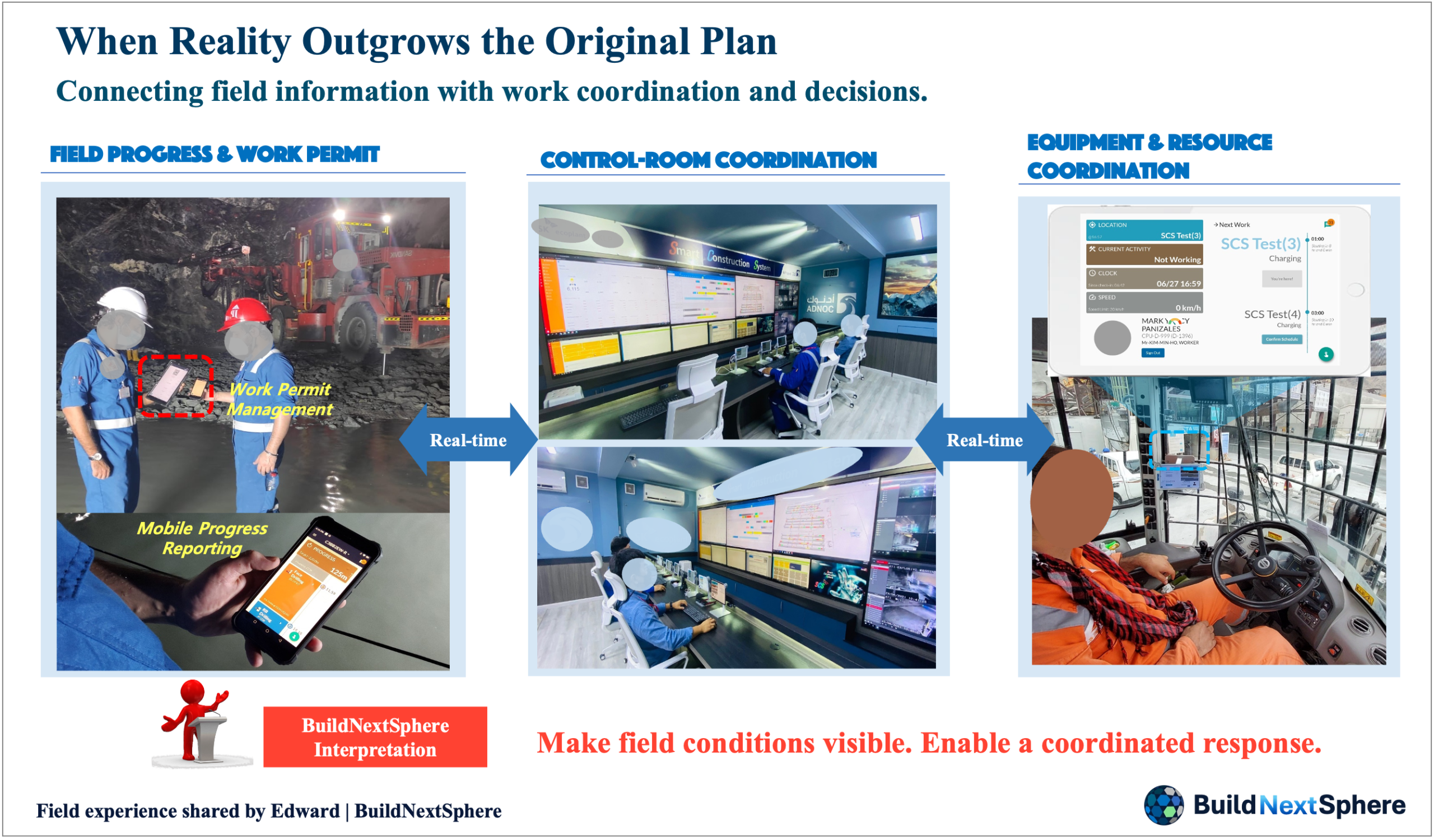
– Figure 5. Connecting field information with coordinated action. Field work reporting and permits, control-room coordination, and equipment/resource coordination illustrate Edward’s project experience.
– Note: These views illustrate work coordination, not the additional ventilation arrangement. This field account does not establish measured cost or time savings, independently verified system performance, or the use of AI.
– Source: Field-experience materials shared by Edward | BuildNextSphere.
These were related responses to different needs. The ventilation work addressed a physical working condition. The management system supported the coordination of activities across the project. Together, they illustrate why a delivery challenge may require both a practical intervention and a change in how information is used.
My central lesson was to reconsider the assumptions behind the plan. A method that appears adequate during early preparation may need adjustment as the extent and interaction of the work become clearer. Teams need a way to identify that gap and bring it to people able to act.
This is a field account, not an independently measured evaluation of the interventions. It does not establish a specific reduction in cost or completion time. The location, dates, capacity and contractual details are omitted to preserve anonymity.
The useful takeaway is an operating habit: compare the planned conditions with the actual conditions, identify what is missing and organise an appropriate response. For another project, the missing condition may be access, an approval, a design decision or an operating resource. The response must follow that project’s evidence.
06. Adapt the Lessons to Local Conditions
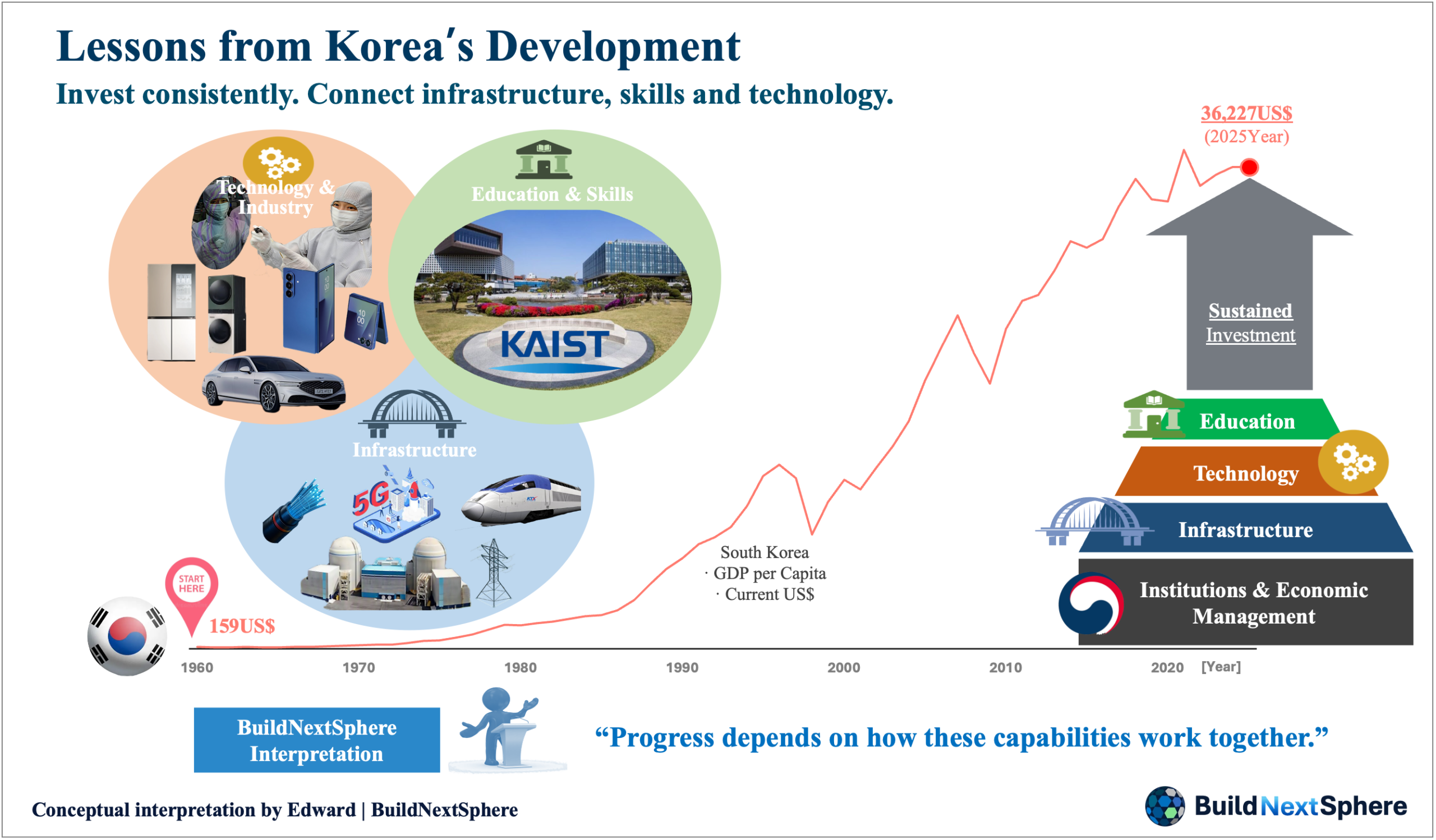
– Figure 6. Connecting capabilities with workable execution. A conceptual illustration of the relationships between capabilities, investment and practical delivery.
– Note: This is an interpretive framework, not a proven causal model, a fixed sequence of investments or a guarantee that the same approach will work elsewhere. Any GDP values shown are in current US dollars.
– Source: World Bank, Republic of Korea overview for development context; interpretation by Edward | BuildNextSphere. Any GDP curve uses WDI — NY.GDP.PCAP.CD.
Learning from Korea does not require assuming that another country should follow the same sequence of investments. Local demand, fiscal capacity, institutions, available skills and maintenance resources should shape the decisions.
For a project team, that principle can become a short set of preparation questions. What need does this investment address? Which assumptions matter most to its usefulness? Who will operate and maintain it? How will changes discovered during delivery reach the people responsible for decisions?
These questions also help distinguish ambition from readiness. A detailed design can coexist with unresolved operating responsibilities. A funding arrangement can coexist with a shortage of trained people. Identifying such gaps early gives the team something specific to resolve.
The lesson extends to international construction examples. BESIX’s account of Burj Khalifa identifies Samsung C&T and Arabtec as partners and describes challenges involving vertical logistics and concrete placement. Its relevance here lies in technical coordination within an international project, rather than a claim of national superiority. Source: BESIX.
Successful-looking landmarks should prompt examination of the work and partnerships behind them. They are not, by themselves, a development strategy. An investment should be judged against the service it is intended to provide and the conditions needed to sustain it.
For organisations working across borders, listening to local operators and delivery teams is part of that preparation. Their knowledge can help test whether a proposed approach fits the environment where it must work.
07. What Will Turn Your Next Opportunity into Progress?
The opening image shows a transformation. The article asks readers to look at the less visible work between the two scenes.
Korea’s experience provides a reason to examine how capabilities can develop over time. Kenya-AIST brings attention to the relationship between a facility and the institution it is intended to support. My field experience adds a smaller, practical lesson: when actual conditions challenge a plan, people need the information, authority and resources to respond.
For your next project, start with one question: which condition must be improved before the intended work can move forward?
The answer may involve a technical change, clearer responsibility, better information or support for the people doing the work. Identifying it turns a broad ambition into a decision that can be discussed and acted upon.
Through BuildNextSphere, I explore these connections between development, technology and project execution. The aim is to help readers examine their own conditions and make more informed choices.
Opportunity opens the door. Execution turns it into progress.
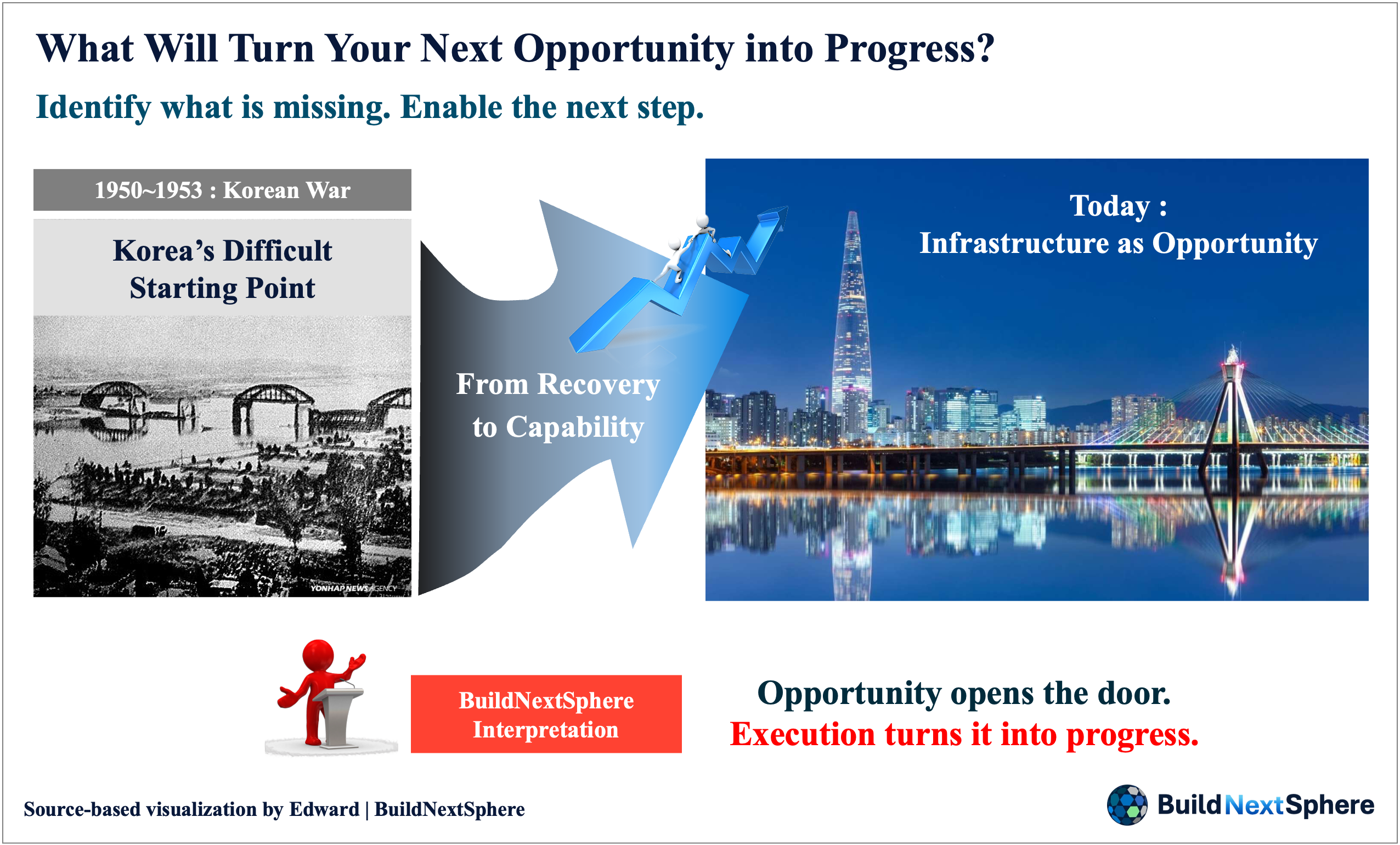
– Figure 7. Turning opportunity into progress. The closing visual returns to the opening contrast and highlights the practical work required to move from opportunity to action.
– Note: “Opportunity opens the door. Execution turns it into progress” expresses the author’s practical interpretation, not a guarantee of project recovery or a complete explanation of national development.
– Source: Visual composition and interpretation by Edward | BuildNextSphere.
Sources
- World Bank, World Development Indicators — NY.GDP.PCAP.CD
- Republic of Korea overview
- KAIST, April 28, 2025 — Kenya-AIST campus completion
- Source: World Bank InfraGov
- Source: BESIX
Basis of This Article
This article combines published development data and institutional sources with Edward Kim’s practical perspective on turning plans and investment into operating capability. The anonymous underground-construction and work-management accounts draw on his direct experience and are not independently evaluated case studies.
The country comparisons are illustrative, not a causal explanation or a development formula. GDP per capita in current US dollars is not a measure of real growth alone, and a campus-completion announcement is not evidence of long-term educational or development outcomes. The proposed lessons require interpretation in their local and project context.
Related Reading
Explore more from BuildNextSphere:
- Why Doesn’t Better Technology Always Deliver Better Construction Results?
- The Future of Construction: Which Technologies will Really Change the Site?
- When Projects Don’t Go to Plan: What Are We Missing?
- Between the Plan and the Site: How Can AI Support Project Execution?
BuildNextSphere
BuildNextSphere connects Development, Technology & Project Intelligence through practical, experience-informed content.
About the Author
Edward Kim is the Founder of BuildNextSphere.
He draws on his experience with overseas construction projects to share practical insights from field operations, project delivery, and IT-enabled working systems. Through BuildNextSphere, he explores how people, technology, and real project conditions can help turn plans into action and support better project outcomes.
Content & IP Notice
This article and related materials are prepared and published by BuildNextSphere. Unless otherwise stated, the original structure, wording, diagrams, frameworks, and visual materials are the intellectual property of BuildNextSphere and Edward Kim.
BuildNextSphere, its logo, tagline, and brand assets are part of the BuildNextSphere brand identity. Unauthorized reproduction, modification, redistribution, or commercial use is not permitted without prior written consent.
Third-party names, technologies, or references are mentioned for informational purposes only and remain the property of their respective owners.
8 Responses