
Why Doesn’t Better Technology Always Deliver Better Construction Results?
A practitioner’s perspective on better development and project execution.
Prepared by Edward Kim/ Founder, BuildNextSphere
01. Better Technology. The Same Old Problems.
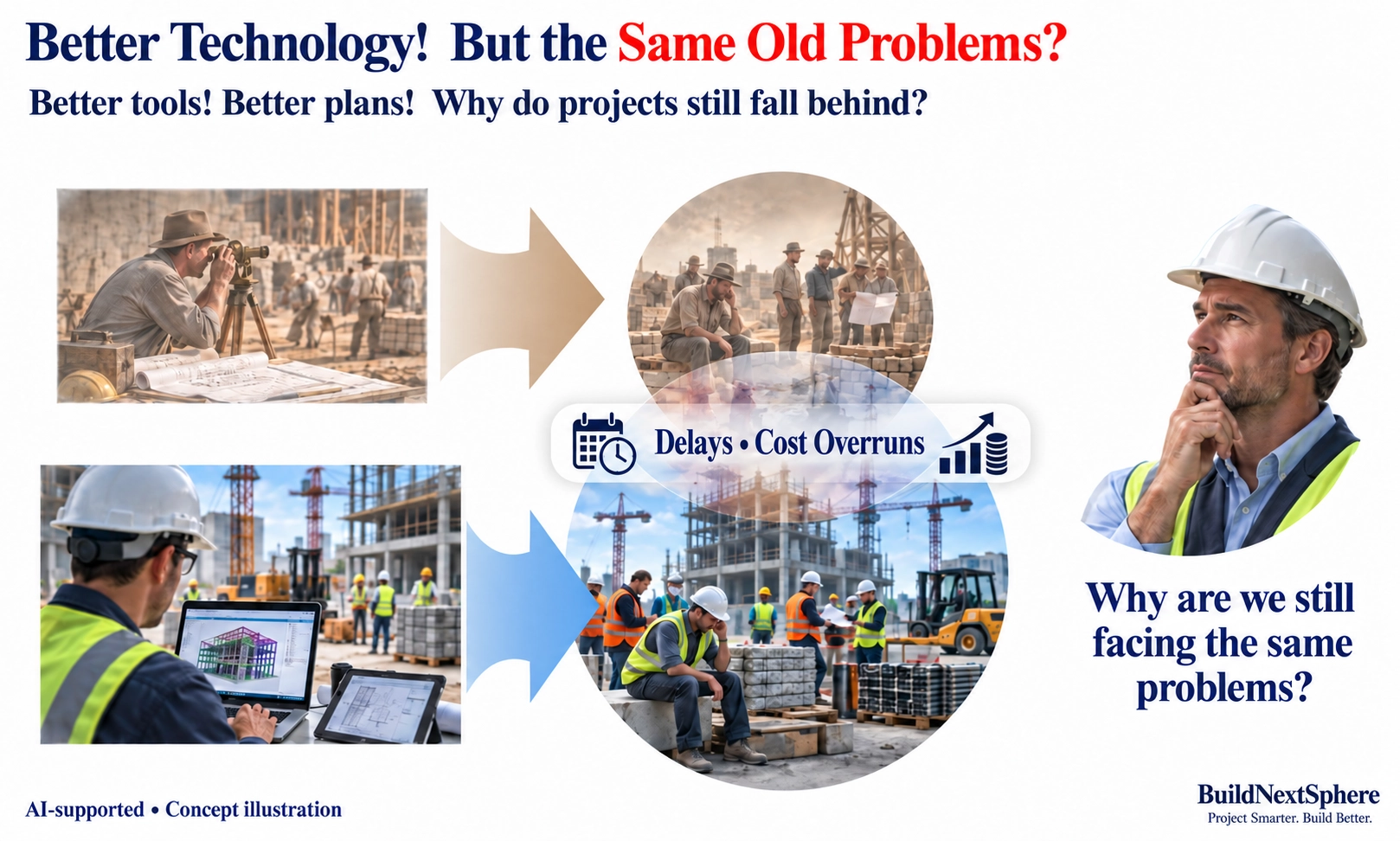
– Figure 1. Better Technology, Unresolved Execution Challenges
– Note: Conceptual scenes contrast better tools and plans with unresolved execution conditions. They are not photographs of an actual project or evidence of measured performance.
– Source: AI-generated concept illustration; layout and editorial direction by Edward Kim | BuildNextSphere.
A project team can now examine buildings and infrastructure before they exist, simulate structures and construction sequences, update schedules on screen, and share information across continents. Yet a familiar question keeps returning: why is the work still falling behind?
Construction project delays are not only a scheduling problem. This article explores the gap between better plans and the conditions people need to put them into practice.
Better tools help us see and plan more. They do not automatically make every decision timely, every instruction clear, or every work area ready. The distance between a convincing plan and a functioning project deserves attention.
The evidence shows recurring difficulties, although it does not describe every project. A 2025 CoST analysis, undertaken with the World Bank, reported delays in roughly 70% of infrastructure projects for which delay information was available. Its wider dataset contained 480 projects, with substantial missing delay information; the percentage is not a global construction failure rate. CoST analysis
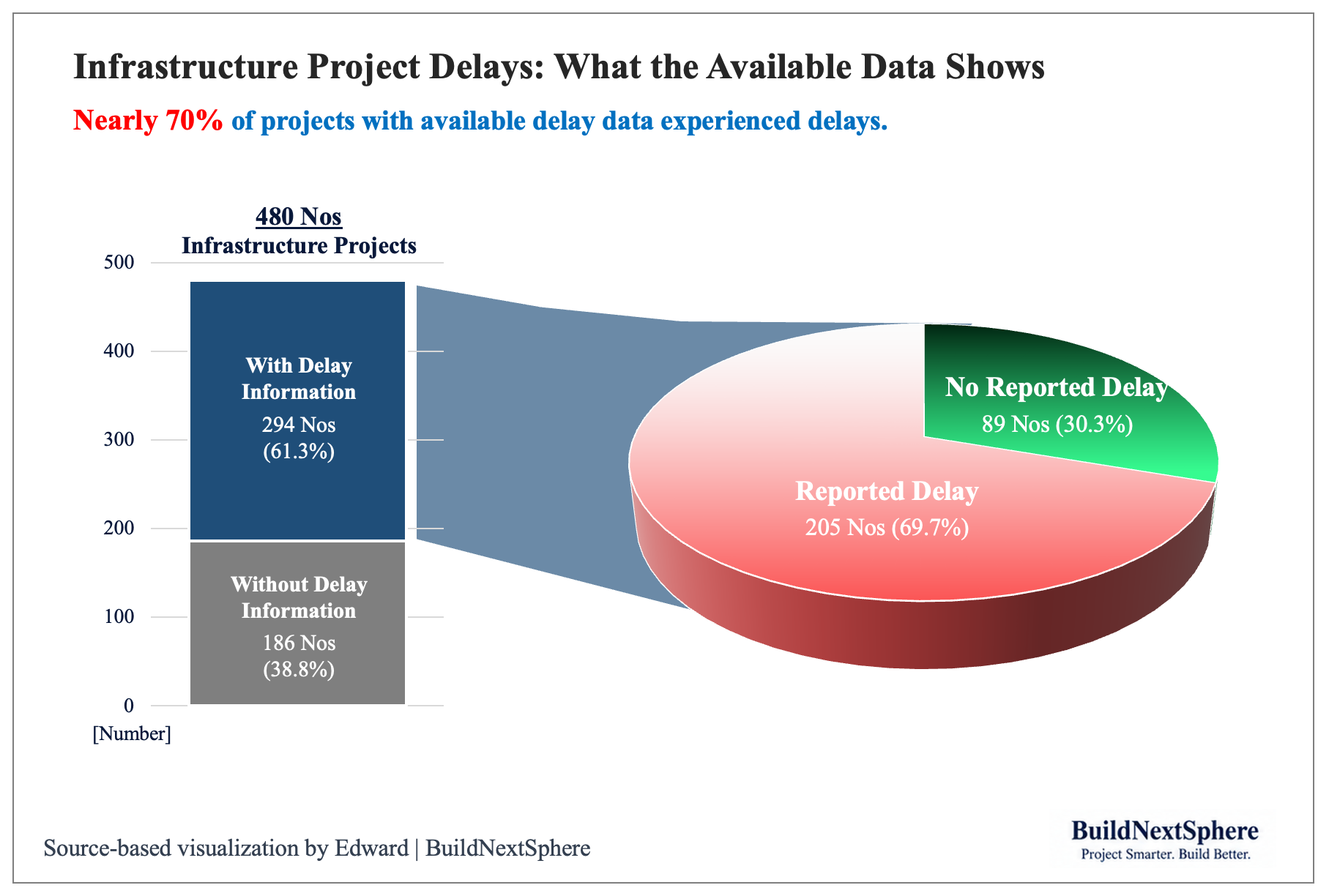
– Figure 1A. Infrastructure Project Delays
– Note: Delay information was unavailable for 186 of 480 projects.
– Source: CoST (2025), analysis in collaboration with the World Bank.
Separately, the European Court of Auditors reported that the combined estimated cost of eight major transport projects had increased by 82% against initial estimates, in constant 2019 prices. These are estimated project costs—not final EPC contract overruns. ECA report
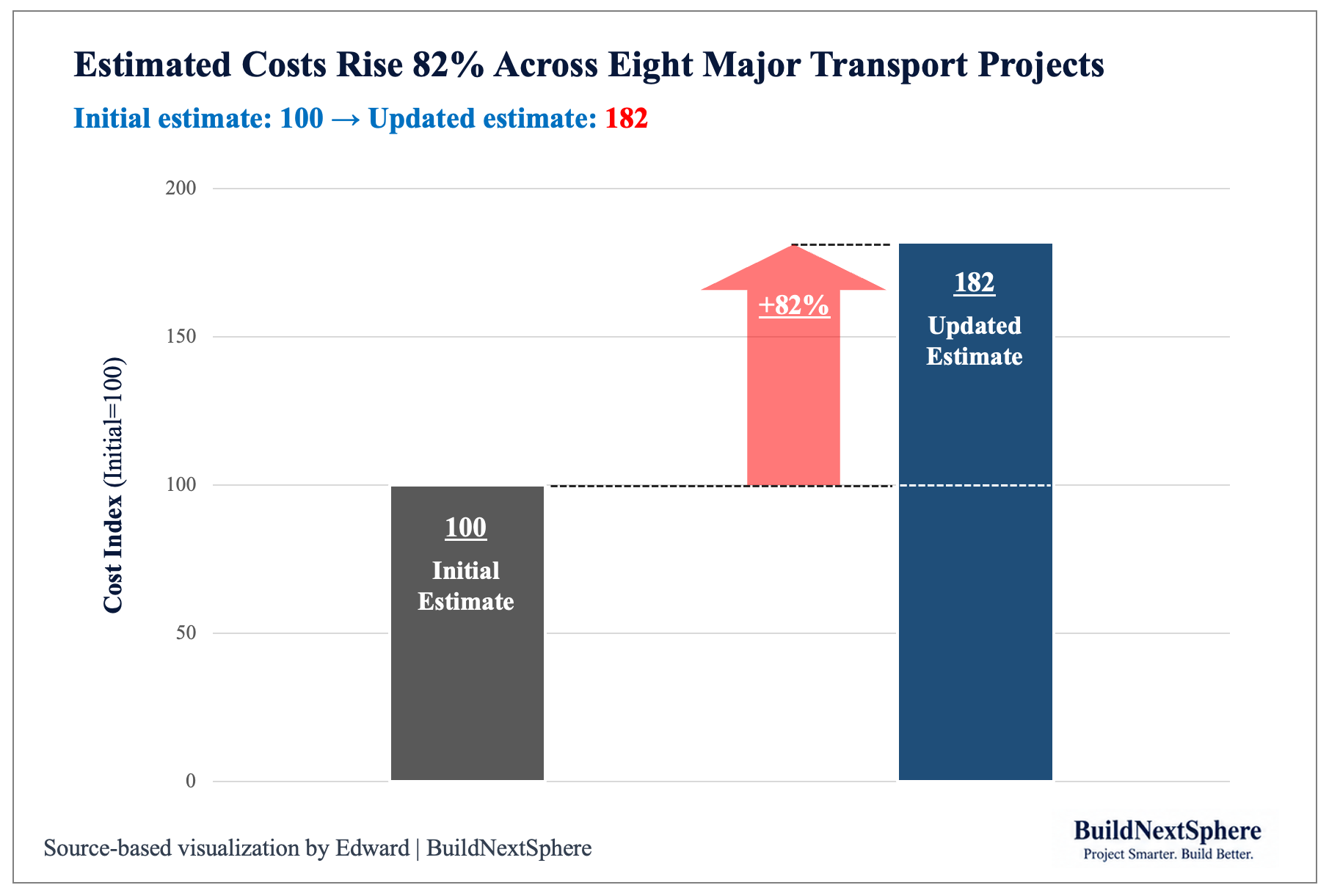
– Figure 1B. Combined estimated project cost — index
– Note: Combined estimated costs of eight major transport projects increased by 82% against initial estimates, in constant 2019 prices—not final EPC contract costs. Figures 1A and 1B represent separate samples and should not be combined.
– Source: European Court of Auditors, Special Report 02/2026; visualization by Edward Kim | BuildNextSphere.
These different samples prompt a useful question, not a universal verdict: what helps good plans become real progress?
02. The Planning–Execution Gap in Construction
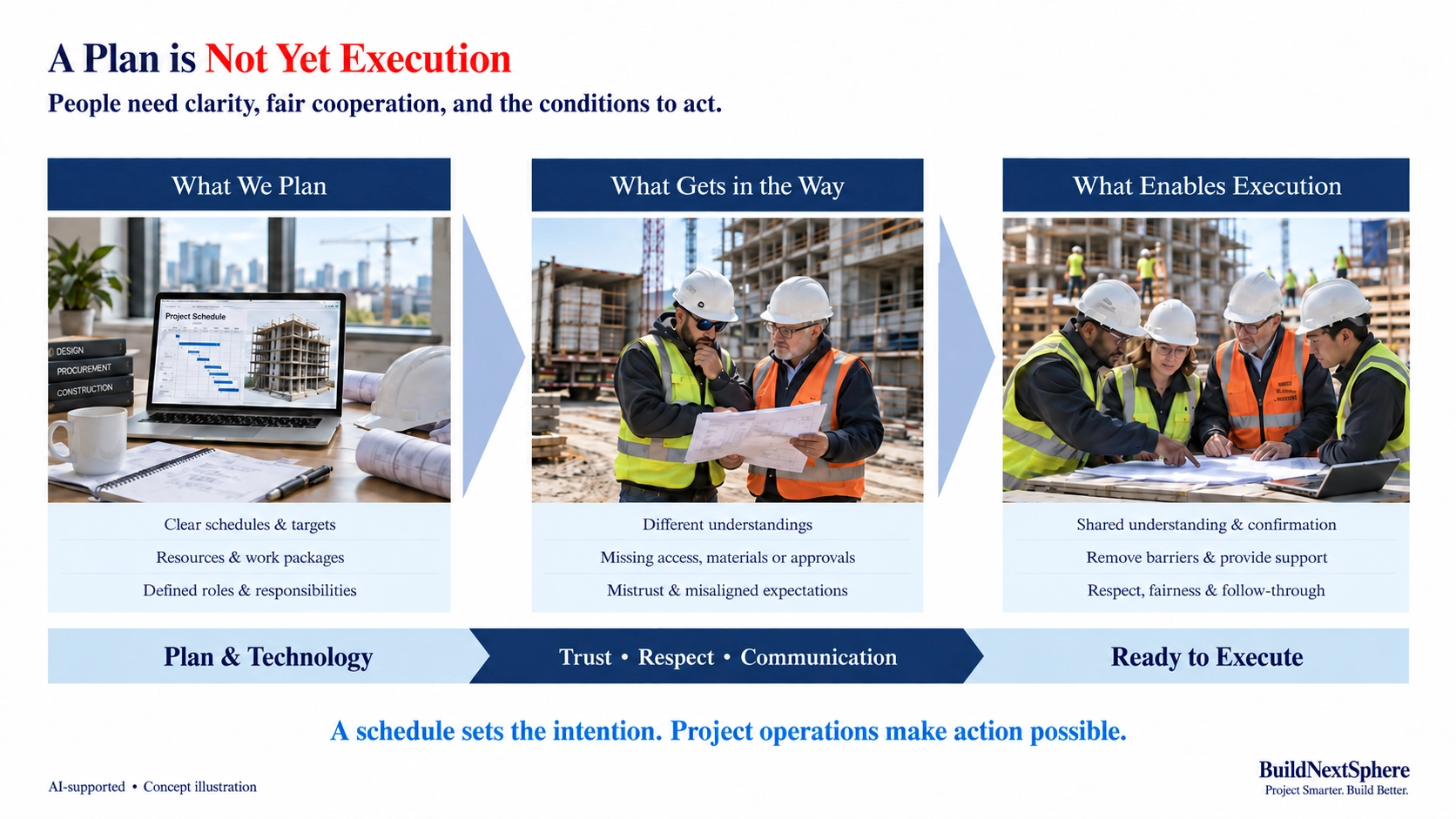
– Figure 2. The Planning–Execution Gap in Construction
– Note: A conceptual illustration of the difference between a planned activity and the conditions needed to execute it. The scene is hypothetical, not a photograph of an actual project or a verified software capability.
– Source: AI-generated concept illustration; layout and editorial direction by Edward Kim | BuildNextSphere.
A schedule tells us what should happen and when. Execution depends on whether people can actually do it.
Imagine a task scheduled for tomorrow. The crew is available, but the latest drawing has not reached the supervisor. Materials are nearby, but access to the work area is blocked. An approval is pending, and nobody knows who will resolve it. The schedule may be logical while the task remains unready.
This is the planning–execution gap. It includes physical constraints, but also differences in understanding, responsibility, and expectations. Sending information is not the same as establishing shared understanding.
A practical daily work plan therefore needs more than an overall schedule. It should connect the intended task with the people, resources, access, approvals, and support required to perform it. When a condition is missing, someone must take responsibility for addressing it.
The point is not to abandon detailed planning. It is to test the plan against actual working conditions—and to make it possible for those closest to the work to explain what is missing.
03. Recovery Began with More Than a Revised Schedule
Edward’s experience on an overseas project illustrates this distinction. Progress had fallen behind, and cooperation among project participants had deteriorated. Revising the schedule alone would not address the conditions under which people were being asked to work.
The response included a deliberately practical starting point: cleaning and organizing the site. This was intended to improve working conditions and reduce unsafe conditions, while making the effort to restore progress visible.
Attention also turned to the treatment of subcontractors’ additional costs and losses, respect for workers, and improvements to welfare. Restoring execution became a priority alongside handling disputed matters. This did not mean abandoning contractual rights.
Edward observed a recovery in progress as these measures were pursued together. His lesson was not that one conversation or one gesture solved the project. It was that rebuilding cooperation required actions people could recognize in their daily work.
This is a field-based account, not an independently controlled evaluation. It cannot isolate how much improvement came from relationships, resources, approvals, or other changes. Its value lies in showing why recovery should address people and working conditions together.
04. People Need a Reason—and the Conditions—to Act
People are more than resources assigned to a schedule. They interpret how they are treated, whether commitments are credible, and whether raising a difficulty will lead to help or blame.
Research offers useful context. Edmondson’s study of 51 manufacturing teams linked psychological safety with learning behavior. It was not a construction study, and it does not establish a construction time-saving percentage. It nevertheless helps explain why the ability to speak about problems deserves management attention. Edmondson, 1999
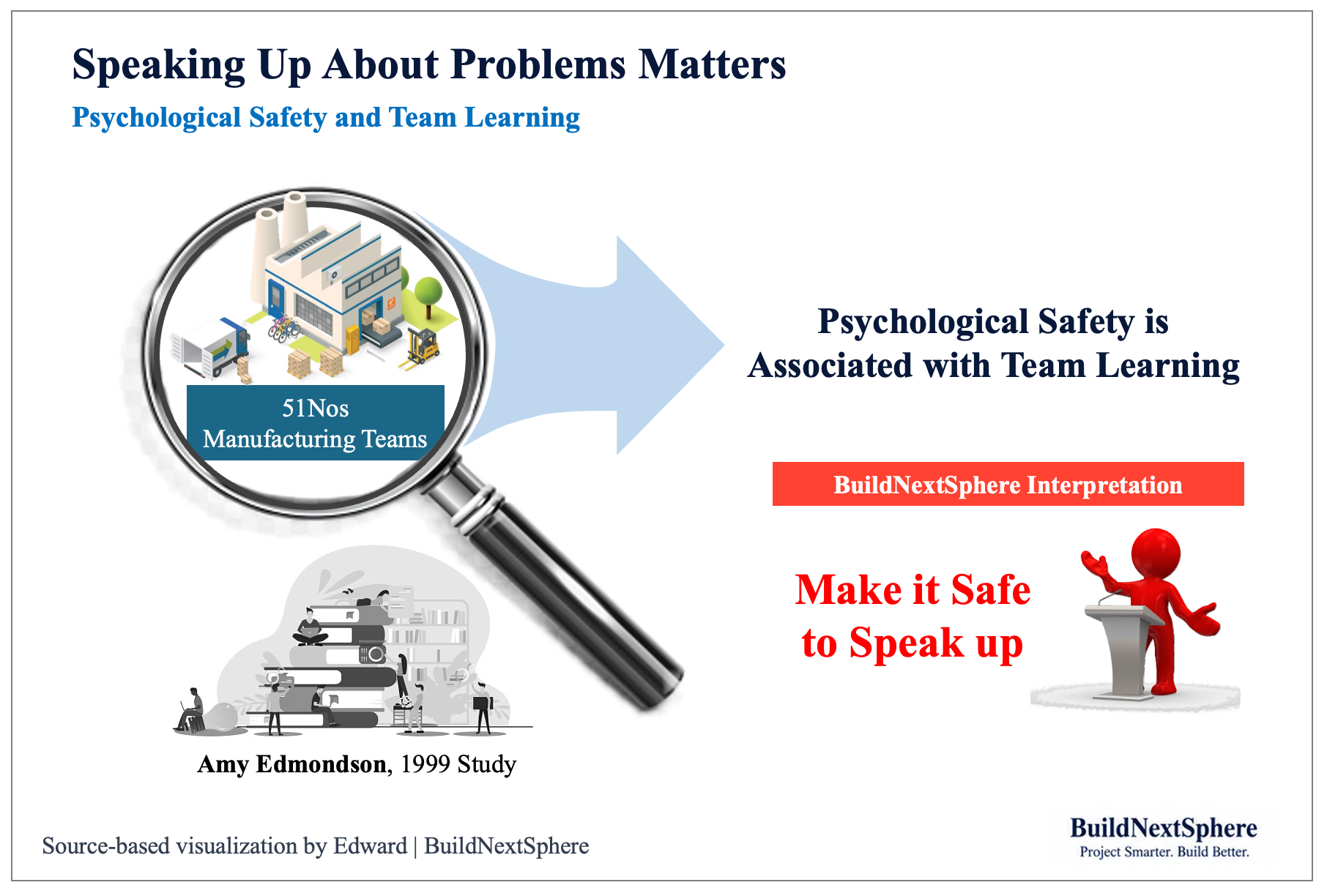
– Figure 3. Psychological Safety and Team Learning
– Note: The study examined 51 manufacturing teams and linked psychological safety with learning behavior. Association—not proof of causation, construction time savings, or this project’s recovery mechanism.
– Source: Edmondson (1999), Psychological Safety and Learning Behavior in Work Teams; source-based visualization by Edward Kim | BuildNextSphere.
In construction, a study of 122 subcontractors in China linked certain perceptions of fairness with willingness to cooperate again. That concerns future cooperation—not proof of immediate productivity improvement. Liu and colleagues, 2017
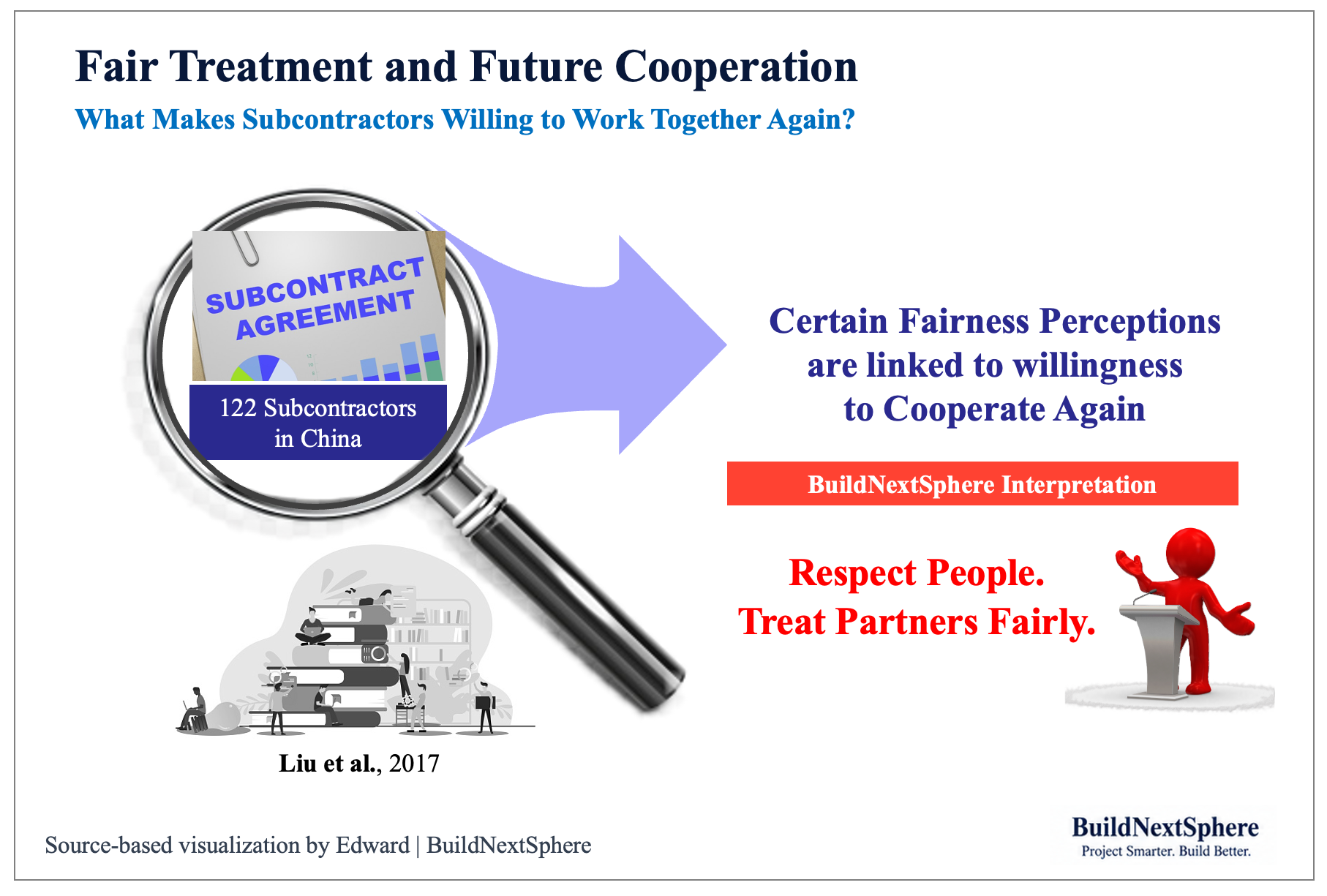
– Figure 4. Fair Treatment and Future Cooperation
– Note: Based on a sample of 122 subcontractors in China, certain fairness perceptions were linked to willingness to cooperate again. Future cooperation intention—not measured immediate productivity improvement or proof of this project’s recovery mechanism.
– Source: Liu et al. (2017); source-based visualization by Edward Kim | BuildNextSphere.
Together, these findings help interpret an operating principle: listen seriously, treat people fairly, and follow through. They do not prove the cause of Edward’s project recovery.
Willingness alone is also insufficient. A respected team still needs usable drawings, materials, access, and decisions. Trust does not replace engineering, finance, contracts, or clear accountability. It should work alongside them.
05. From Reporting Problems to Enabling Action: Four Practical Steps
A useful project meeting should leave the work better supported, not merely better described. This suggests a simple shift in the questions managers ask.
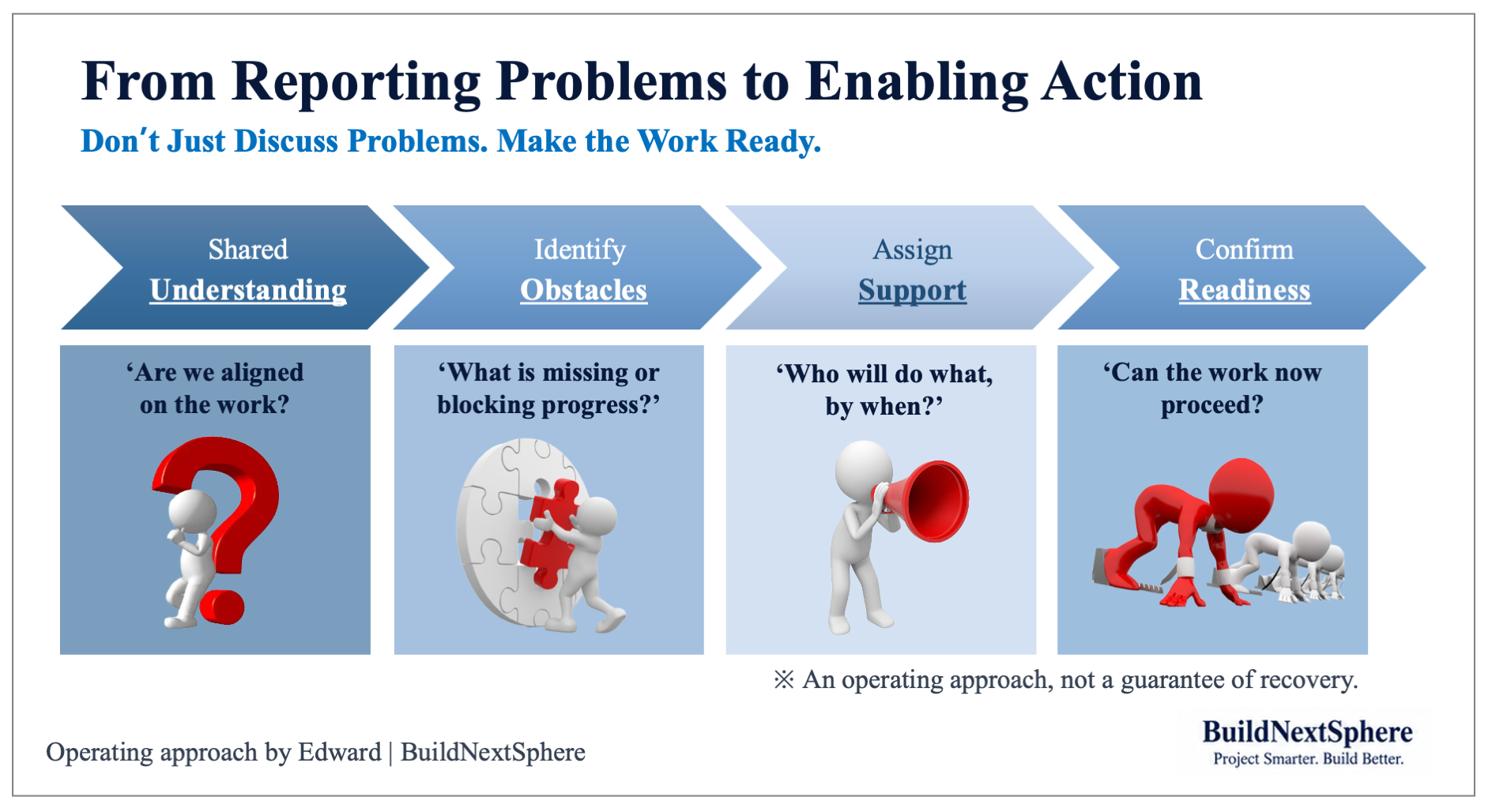
– Figure 5. From Reporting Problems to Enabling Action
– Note: Shared understanding → identify obstacles → assign support → confirm readiness. This is a proposed operating approach, not an official standard, a complete site procedure, permission to start work, or a guarantee of recovery.
– Source: Operating approach and visual composition by Edward Kim | BuildNextSphere.
First, establish shared understanding: what work is intended, and do the people involved understand it in the same way?
Second, identify the obstacle: what could prevent execution? Ask about missing information and approvals as readily as labor or equipment.
Third, assign support: who can remove the obstacle, what decision is needed, and when must it happen?
Finally, confirm readiness: has the obstacle been removed, and can the work now proceed?
These questions are an operating approach, not a promise of guaranteed recovery. They encourage responsibility while making support visible.
Digital tools can help connect this process. A daily work plan, a shared issue record, and timely communication can support a common view of conditions. Early warning becomes useful when it prompts a decision or assistance before the problem grows.
The objective is not more alerts or longer reports. It is to give engineers and managers time to understand the site, exercise judgment, and obtain timely support—including from head office when local teams cannot resolve an issue.
06. Shared Principles, Different Local Realities
The principles may travel; the exact method should not be copied without thought.
On international projects, shared understanding can be affected by language, professional backgrounds, working practices, and differing expectations. A message that appears straightforward to one participant may leave another uncertain about the required action.
In emerging markets, teams should examine the actual local setting rather than assume that a familiar tool or procedure will fit. Consider who can access the information, how questions are raised, and what support is realistically available. These are project-specific questions, not judgments about an entire country.
Respect and fair treatment remain guiding principles. Their practical expression may require different meeting formats, clearer explanations, or different routes for escalating a constraint.
The lesson from one recovery experience is therefore not “repeat these steps everywhere.” It is “understand what prevents these people, in these conditions, from working together effectively.” Local knowledge is part of that understanding.
07. Better Projects Begin with People

– Figure 6. Better Projects Begin with People
– Note: The conceptual scene illustrates respect, cooperation and practical support alongside plans and technology. It does not depict the actual recovery project or demonstrate a measured causal effect.
– Source: AI-generated concept illustration; layout and editorial direction by Edward Kim | BuildNextSphere.
Good plans and technology are essential starting points. Turning them into outcomes also requires an operating environment in which people can reveal problems, cooperate fairly, and obtain the conditions needed to act.
That is not an argument for choosing relationships over technical discipline. It is an argument for connecting them. Respect without practical support can become an empty promise; information without action can become another reporting burden.
BuildNextSphere approaches this connection through development context, the possibilities and limits of technology, and the judgment needed for project execution. These perspectives offer complementary ways to explore why projects struggle and how their operation might improve.
The starting question is deliberately simple: in your project, what is stopping the next planned activity from becoming completed work?
Ask the people closest to it. Listen to what they identify. Then consider whether the missing element is information, a decision, a resource, or a commitment that has not been kept.
Better projects begin with people—and with the practical work of enabling them to act.
Sources
Basis of This Article
This article presents Edward Kim’s practical perspective on the connection between people, working conditions and project execution. The anonymous overseas-project recovery account draws on Edward’s direct experience and is not an independently controlled evaluation. The scheduled-task example is hypothetical.
The cited reports and studies provide context; their different samples and settings do not establish a universal construction delay rate or prove the causes of the reported project recovery. The practical steps proposed here require judgement against each project’s conditions, resources and responsibilities.
Related Reading
Explore more from BuildNextSphere:
BuildNextSphere
BuildNextSphere connects Development, Technology & Project Intelligence through practical, experience-informed content.
About the Author
Edward Kim is the Founder of BuildNextSphere.
He draws on his experience with overseas construction projects to share practical insights from field operations, project delivery, and IT-enabled working systems. Through BuildNextSphere, he explores how people, technology, and real project conditions can help turn plans into action and support better project outcomes.
Content & IP Notice
This article and related materials are prepared and published by BuildNextSphere. Unless otherwise stated, the original structure, wording, diagrams, frameworks, and visual materials are the intellectual property of BuildNextSphere and Edward Kim.
BuildNextSphere, its logo, tagline, and brand assets are part of the BuildNextSphere brand identity. Unauthorized reproduction, modification, redistribution, or commercial use is not permitted without prior written consent.
Third-party names, technologies, or references are mentioned for informational purposes only and remain the property of their respective owners.
9 Responses